



RFID (radio frequency identification) and NFC (near field communication) are contactless technologies that use radio waves to identify, track, and exchange data. While they share a common foundation, they are designed for very different purposes.
RFID is built for speed and scale. It enables tags to transmit data to a reader from a distance, often in milliseconds and without line of sight. RFID systems use passive or active tags and operate across multiple frequency ranges, making them well suited for warehouse inventory, logistics, retail tracking, libraries, and toll systems. Security varies by implementation, with advanced systems supporting encryption and authentication.
NFC, a specialized form of high-frequency RFID operating at 13.56 MHz, focuses on secure, close-range communication. It works over just about an inch, and supports two-way, peer-to-peer exchanges. This design makes NFC ideal for intentional, user-driven interactions such as mobile payments, access control, ticketing, and identity verification.

| Aspect | RFID | NFC |
| Operating range | Works at a distance | Works at very close range |
| Primary strength | Speed and volume | Security and control |
| Typical scale | Large numbers of items | Individual items or users |
| Security level | Depends on implementation | High by design |
| Common applications | Inventory, logistics, asset tracking | Payments, access control, ticketing |
In practice, RFID is best suited for environments where distance and volume matter most, while NFC excels when secure, individual exchanges and a smooth user experience are required.
Difference Between NFC and RFID: Key Practical Factors
One of the biggest differences between RFID and NFC is how far they can work and that difference strongly affects where each technology makes sense.
RFID comes in several forms, each suited to a different range and environment:
- Short-range RFID is used when tags need to work reliably near metal, liquids, or in rough conditions, such as industrial access badges or animal tracking.
- Medium-range RFID is common in transit cards and building access systems, and it also forms the basis for NFC.
- Long-range RFID is designed for logistics and inventory, where many items need to be identified at once, sometimes from several meters away. This is how warehouses can scan entire pallets or moving goods in seconds.
NFC is a specialized form of medium-range RFID, but it intentionally works at a very short distance of just a few centimeters. This close range improves security and control, making NFC ideal for payments, ticketing, and access control. It also works seamlessly with smartphones, without the need for additional equipment.
The choice between RFID and NFC depends on how the technology will be used. When the goal is to track large numbers of items quickly and from a distance, RFID is the better fit. When the priority is a secure, intentional interaction, NFC is the preferred option.
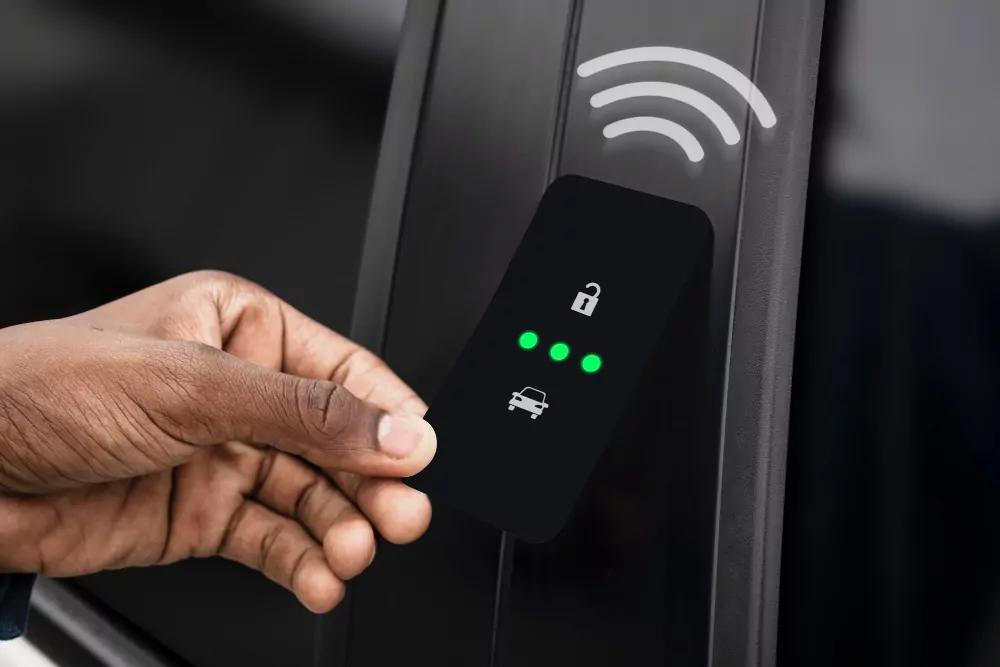
In many real-world systems, both technologies are used together. For example, a hospital may track equipment with long-range RFID while using NFC for staff access or patient check-ins.
Curious about the best approach? Learn more about IoT product development.
NFC vs RFID: Communication Features
RFID and NFC differ mainly in how they communicate and how security is handled. Traditional RFID systems use a one-way interaction: a reader broadcasts a signal, and any compatible tag within range responds automatically. Because the tag does not verify who requested the data, RFID is highly efficient for large-scale scanning and automation. This simplicity makes it well suited for inventory management, asset tracking, and automated toll systems.
NFC, by contrast, is designed for two-way, peer-to-peer communication. Both devices actively participate in the exchange before data is shared. This approach enables common actions such as tapping a phone to pay or sharing information between devices. NFC focuses on intentional, close-range interactions, which reduces accidental or unauthorized exchanges.
Security Considerations and Use-Case Trade-offs
Security is important in both technologies, but it is handled differently. Basic passive RFID, especially at lower frequencies, can be vulnerable if no protection is used. More advanced RFID systems improve security through encryption, though risks remain if systems are poorly configured.
NFC relies on short range and mutual authentication to enhance security. Its limited operating distance reduces interception risk, and modern NFC systems often add layers such as dynamic credentials and device-level authentication. Physical access to a card or phone can still pose risks, which is why locks and biometric checks are commonly used.

Security and suitability overview:
- RFID works well at scale when security requirements are moderate or properly implemented
- NFC is designed for secure, individual exchanges
- RFID excels in logistics and warehousing, while NFC is preferred for payments, access control, and identity verification
In practice, the choice comes down to scale versus security. RFID is favored where speed and volume matter most, while NFC is chosen when trust, privacy, and controlled interaction are essential.
Choosing RFID or NFC: How to Decide for Your Project
Choosing between RFID and NFC is like picking shoes: the choice depends on the path ahead.
- RFID: Perfect for identifying many things at once, over distance, hands-free. Examples include airport bags, inventory systems, and hospital asset tracking, where everything from beds to medical equipment is monitored without daily confusion.
- NFC: Ideal for each tap of your phone to pay, check in, or enter a room. NFC devices and tags exchange data up close, only when standing near enough to pass a note. This design keeps each transaction safe and personal.
Complexity and user expectations drive the choice. Do you want broad, invisible automation (RFID), or close, secure, user-driven interaction (NFC)?
Cost plays a big role, too:
- Passive RFID tags are very cheap, allowing for expansive deployment. However, readers and infrastructure require investment and careful planning.
- NFC requires fewer readers since many smartphones or tablets can serve as the reader and tag. This leads to lower startup costs when user devices are standard. Still, deploying thousands of NFC tags for bulk use doesn’t make sense.
RFID is best for large, automated, high-volume tasks. NFC excels in person-to-person, user-focused interactions or payments. Always consider local regulations, spectrum allocation, and privacy rules before launching a project. For more details on integration and feasibility, we at AJProTech offer guidance here.
FAQ about RFID and NFC
What challenges do RFID and NFC solve better than other identification methods?
RFID and NFC excel where speed, automation, and contactless operation are essential. RFID can identify large volumes of items at once and from a distance, making it ideal for inventory tracking and asset management. NFC is optimized for secure, one-to-one interactions, such as payments or access control, where close proximity reduces errors and improves security.
What are the main limitations in real-world RFID and NFC deployments?
RFID performance can suffer near metal, liquids, or tightly packed items, and system costs grow with readers, integration, and scaling. NFC’s very short range improves privacy but prevents bulk scanning. Both technologies may face integration challenges with legacy systems, user adoption issues, and regional regulatory constraints.
How do security risks compare between RFID and NFC?
Basic RFID tags can be vulnerable if encryption is not used, especially at lower frequencies. More advanced RFID chips support authentication and encryption when properly configured. NFC adds security through short range and cryptographic handshakes, often combined with biometrics or PINs, though physical device access still presents risks.
Where does the range difference between RFID and NFC matter most?
RFID is best for bulk identification in warehouses, logistics, healthcare, and baggage handling, where long-range scanning saves time. NFC is ideal for secure, individual interactions like payments, event check-ins, or access control, where close-range communication prevents accidental or unauthorized reads.
How do RFID and NFC compare in cost?
RFID tags are inexpensive, but readers, infrastructure, and system integration can be costly as deployments scale. NFC benefits from existing consumer devices and compact readers, keeping entry costs lower, though advanced security and system maintenance can increase long-term expenses.
Can RFID and NFC be used together in one system?
Yes. Many systems combine RFID for long-range asset tracking with NFC for secure access or user authentication. Hybrid deployments use middleware to unify data, but require careful planning to manage compatibility, privacy, and interference. When designed well, the two technologies complement each other effectively.