


Best EEG devices of 2026 at a glance
- Emotiv Epoc X leads for research-grade EEG (electroencephalograms),
- OpenBCI Ultracortex Mark IV is the go-to for custom brain-computer interface work,
- Muse S Athena blends EEG with fNIRS for wellness tracking,
- Neurable MW75 Neuro hides EEG inside everyday headphones,
- NextSense Smartbuds take in-ear EEG into true-wireless sleep monitoring.
We break down this ranking by use case, not by chasing a single “best” score. EEG hardware now covers several categories: lab-focused headsets, open-source platforms, wellness wearables, and headphones that tuck EEG sensors into familiar shapes. It’s not a cosmetic shift: EEG, once reserved for neuroscience labs and clinical trials, now appears in products built for daily routines.
| Rank | EEG device | Best fit | Why it stands out in 2026 |
| 1 | Emotiv Epoc X | Research-grade EEG workflows | Better suited for structured EEG data collection than for casual brainwave tracking. |
| 2 | OpenBCI Ultracortex Mark IV | Custom brain-computer interface work | The clear choice for experimental BCI prototypes, custom electrodes, and open research tooling. |
| 3 | Muse S Athena | Wellness, relaxation, and meditation tracking | Combines EEG with fNIRS, so wellness teams get more context than from a standard brain sensing headband. |
| 4 | Neurable MW75 Neuro | Premium everyday focus tracking | Embeds EEG into headphones, reducing the adoption friction compared to dedicated EEG headsets. |
| 5 | NextSense Smartbuds | Sleep-focused in-ear EEG | True-wireless earbuds shape makes overnight EEG realistic where comfort is critical. |
Here’s the core engineering split: scalp-based systems give you more control over electrode placement and signal quality, while in-ear or headphone-based options trade away some flexibility for wearability. Neither is automatically “better.”
For a neurofeedback device or EEG research platform, we’d start by looking at sensor access, raw signal availability, and repeatable fit. For consumer EEG, comfort, battery life, and user stickiness after week one matter more.
Electrode selection, pressure points in the enclosure, wireless EEG constraints, firmware timing, and the mobile app all have to work as a single system. Miss one mechanical tolerance and the best electronics in the world will still produce noisy data.
Our Expertise
For founders developing a new wearable EEG device, our wearable product development work is often where the scoping conversation begins.
At AJProTech, we build award-winning hardware from concept to mass production, combining product design, mechanical and electrical engineering, rapid prototyping, and manufacturing support under one roof.
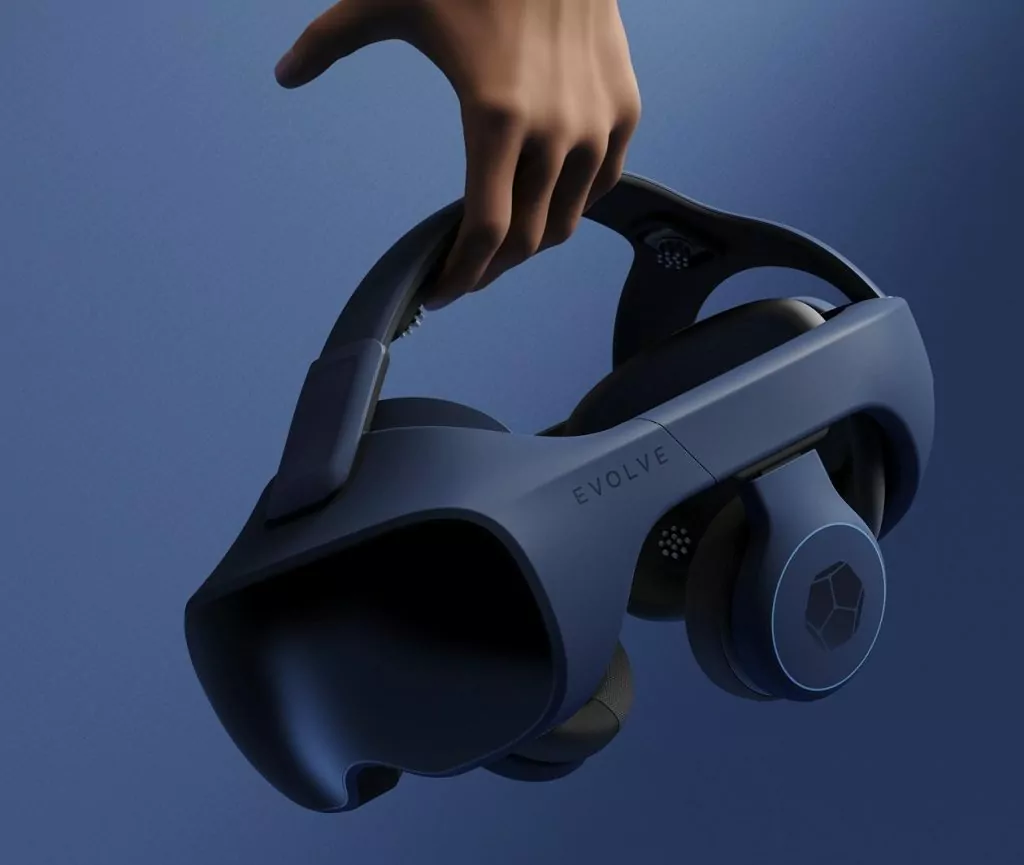
This gives us a practical lens for evaluating EEG headsets beyond marketing claims: signal quality, electrode design, comfort, fit stability, connectivity, battery life, and manufacturability.
In this review, we highlight the wearable EEG devices that show the strongest balance of technical execution, usability, and real-world product readiness. But before comparing models, it helps to determine what an EEG device actually is and why these categories matter.
What is an EEG device, and what types exist
EEG devices record the brain’s electrical activity using electrodes or sensors placed on the scalp. These sensors pick up tiny voltage changes created by clusters of firing neurons. The hardware amplifies those signals, filters out noise, and delivers EEG data for analysis, neurofeedback, or brain-computer interface projects.
The EEG devices in 2026 span several shapes:
- full-cap clinical and research systems with 32+ gel-based electrodes,
- wireless EEG caps for mobile recordings, consumer headbands,
- in-ear EEG inside true-wireless earbuds,
- EEG-equipped headphones,
- modular/open-source builds for prototyping,
- XR-integrated multimodal headsets.
Electrode type matters here: gel contacts offer the cleanest signals, saline balances setup and quality, and dry EEG trades off some fidelity for faster use.
“Medical vs consumer” is not the meaningful split here. Instead, it’s about channel count, contact method, motion tolerance, software openness, and how much raw signal the system actually exposes.
- A clinical EEG cap is built for high-quality electroencephalography and controlled research.
- A consumer EEG headband is usually tuned for meditation tracking or simple brainwave trends—not the same engineering challenge.
For teams planning a custom build, our hardware development work is the next logical step because EEG hardware sits at the intersection of analog front-end design, mechanical fit, firmware timing and human factors. Hardware failures almost always start at the contact interface: a headset that can’t keep steady scalp contact won’t generate usable data outside the lab.
With those distinctions in mind, we can walk through how we actually evaluated and ranked the top EEG headsets for 2026.
How we ranked the top 5 EEG headsets for 2026
We ranked these devices by engineering fit, not by who stacked the most features. Key criteria: comfort, electrode stability, microvolt-level signal fidelity, software maturity, real-time visualization, data capture depth, portability, cost, and whether the device fits research, everyday use, or both.
Across the commercial hardware projects we’ve shipped at AJProTech, one pattern stands out: skin-contact stability, enclosure pressure, and low-noise acquisition make or break EEG in the field: spec sheet sensor counts don’t tell the whole story.
EEG is unforgiving. Useful brain activity is buried in small electrical signals, while hair, sweat, motion, cable strain, or bad scalp contact can swamp the recording. Don’t be fooled by the numbers alone.
| Ranking criteria | What we looked for | Why it matters |
| Comfort and fit | Headset pressure, weight, adjustability, wear duration | A device that slips after 15 minutes won’t yield reliable data |
| Electrode quality | Dry vs conductive contact, placement repeatability, skin stability | The hardware interface decides if the signal is useful before the software sees it |
| Signal quality | Noise rejection, artifact handling, repeatable microvolt capture | Brainwave signals are subtle; both mechanical and analog design count |
| Software ecosystem | SDKs, export formats, dashboards, app quality | Good hardware is stifled if data collection is locked down or docs are thin |
| Real-time visualisation | Latency, clarity, feedback, neurofeedback readiness | Real-time feedback is critical for meditation, BCI demos, and training |
| Portability | Wireless stability, battery design, setup speed | Mobile EEG depends on reliable operation and fast setup outside the lab |
| Use-case fit | Research vs consumer, clinical vs wellness | A relaxation headset isn’t built for event-related potentials or academic rigor |
| Price-to-capability ratio | Practical value for the user | Cheapest isn’t always best; over-specifying for daily use is wasteful too |
For 2026, we added a filter other lists often miss: form-factor and sensor-stack relevance. EEG is moving toward smaller wearables, in-ear concepts, multimodal sensing, and on-device AI for artifact rejection.
That doesn’t make every legacy headband obsolete, but it does change how we look at a device that still treats wireless EEG as a novelty.
We also split “usable for neuroscience” from “pleasant for daily wellness.” A brain sensing headband can be excellent for meditation but not strong enough for research.
In our wearable hardware work, we follow the same principle: start with the contact mechanics and acquisition path, then build the application layer on top of signals you can actually trust.
Form-factor and software ecosystem are the two most debated criteria, and they drive nearly every difference between the five top devices below.
Top 5 EEG devices of 2026, picked case-by-case
| Device | Price band | Channel count | Form factor | Target user |
| Emotiv Epoc X | Research / prosumer | 14 channels | Wireless EEG headset with saline electrodes | EEG research, clinical pilots, advanced prototyping |
| OpenBCI Ultracortex Mark IV | Modular open-source kit; varies by board/build | 8–16 channels | 3D-printable open-source headset | BCI builders, custom experiments, academic research |
| Muse S Athena | Consumer wellness | EEG + fNIRS consumer setup | Flexible dry-electrode headband | Meditation, relaxation, sleep, focus tracking |
| Neurable MW75 Neuro | Premium headphone; $699 retail | 12 channels | Active-noise-cancelling headphones with fabric sensors | Productivity, focus, daily use |
| NextSense Smartbuds | Consumer sleep-tech | 6 EEG sensors | True-wireless in-ear earbuds | Sleep tracking, slow-wave stimulation, recovery monitoring |
By 2026, the leading EEG devices fall into two groups: research-first systems that win on channel access and raw signal control, and wearables that disguise electroencephalography inside headbands, headphones, or earbuds for daily tracking.
1. Emotiv Epoc X — research-grade staple
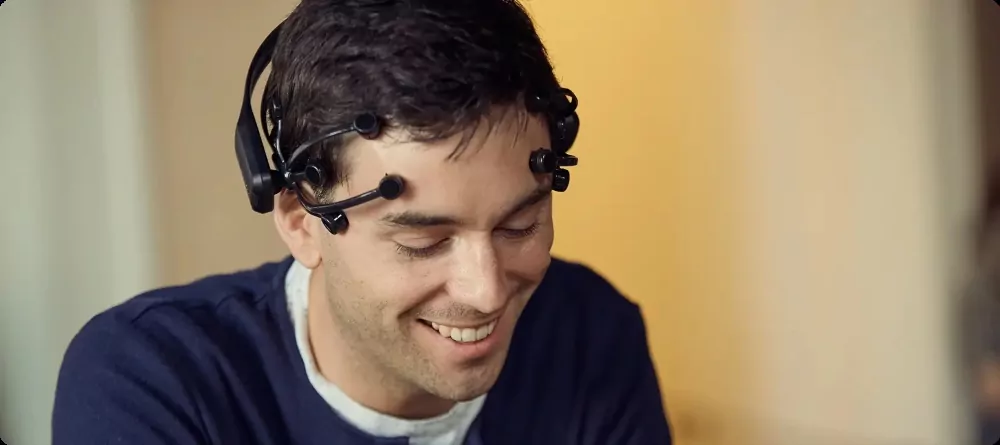
For lab researchers, we’d start by balancing experimental control with convenience. Emotiv Epoc X is the easier route when you want a packaged headset, guided setup, and less time building hardware. It’s the practical go-to when you need a 14-channel wireless EEG headset.
Saline electrodes provide broad scalp coverage, and the system supports 128/256 Hz sampling, Bluetooth 5.0, and full data export through a mature SDK.
That combination explains its presence in research, clinical pilots, academic studies, and advanced prototyping. It isn’t a casual wellness gadget. Instead, it’s a tool for teams that need repeatable data, raw signal access, and enough software control for serious analysis.
The trade-off is straightforward: you get research-grade workflows and the setup complexity of saline electrodes and lab-style fit. For many labs, that’s a fair exchange.
2. OpenBCI Ultracortex Mark IV — modular BCI builders’ platform

For BCI builders, Ultracortex is usually the natural fit because brain-computer interface projects live or die on raw signal access and integration freedom.
You’ll find it in custom BCI projects, nonstandard EEG experiments, and hands-on neuroscience work where electrode placement counts more than onboarding polish. The headset is 3D-printable and open-source, pairing with OpenBCI Ganglion, Cyton, or CytonDaisy boards for 8–16 channels.
The upside is total control. Builders can use dry or conductive electrodes, choose from up to 35 different 10-20 system positions, and tweak the frame itself when a standard headset won’t fit the experiment. This flexibility explains why Ultracortex is widely described as the world’s most used open-source EEG headset.
Naturally, the downside is also the point: this isn’t the simplest route if your goal is a polished consumer EEG product on a tight timeline. Fit may need adjustment, electrode contact can be inconsistent, and there’s a learning curve steeper than with app-led consumer kits.
3. Muse S Athena — wellness multimodal (EEG + fNIRS)
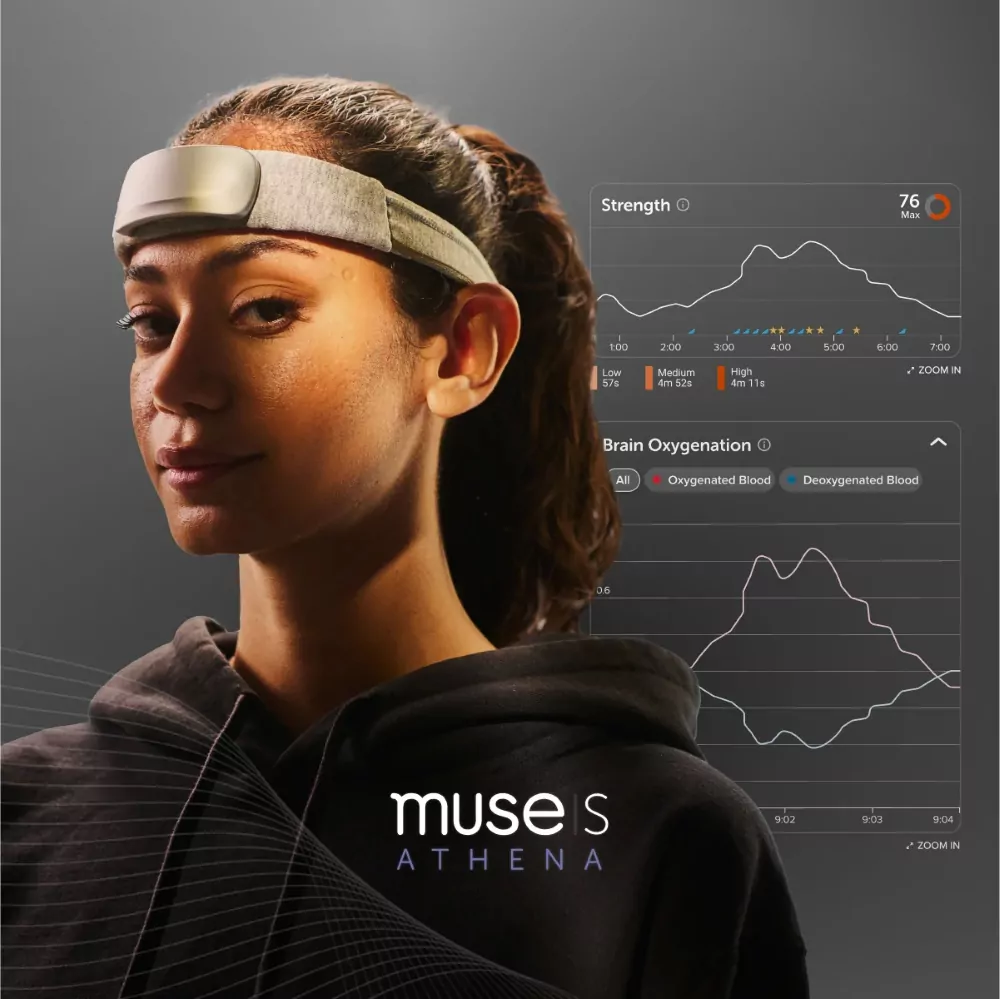
For meditation and wellness, Muse S Athena fits best because the product is built for fast setup, comfort, and feedback rather than open-ended experimentation.
Its 2026 significance comes down to one update: Interaxon introduced it in March 2025 as the first consumer headband to combine EEG with fNIRS (functional near-infrared spectroscopy). That’s important because EEG tracks electrical activity, while fNIRS adds a hemodynamic (blood-oxygenation) signal tied to brain function.
The direction is clear: meditation, relaxation, sleep tracking, and focus. Muse uses a soft, flexible headband, dry electrode setup, app-led routines, and AI-driven neurofeedback so nontechnical users get actionable cues.
This is where consumer EEG has improved. Devices that once belonged in labs now sit next to sleep masks and fitness wearables. Muse S Athena fits that shift, with a quick setup and an app that transforms measurement into real guidance.
4. Neurable MW75 Neuro — EEG inside premium headphones

Neurable MW75 Neuro aims at a different persona: someone who wants focus tracking in something they’re already wearing. A user who won’t put on a clinical-looking headband for work might happily put on headphones for meetings, focus sessions, or travel. This form factor changes the adoption story.
Built on the Master & Dynamic MW75 platform, Neurable’s version uses 12-channel EEG captured through soft fabric sensors in the ear pads, with 0–131 Hz bandwidth and True DC Coupling.
Technical tradeoff: ear-pad EEG doesn’t cover the scalp as thoroughly as a full headset, but it makes continuous productivity tracking much more plausible. For everyday EEG, that’s the leap: less lab gear, more routine wear.
Neurable points to Mayo Clinic testing, and the $699 price tags MW75 Neuro as a premium headphone, not a research tool. The MW75 Neuro LT follow-up pushes this idea further. For those tracking the evolution of portable EEG, this is the industrial design to watch.
For teams building wearables, our wearable product engineering work often starts with this same question: what will users actually tolerate wearing, and where can sensors hide without trashing signal quality?
5. NextSense Smartbuds — true-wireless in-ear EEG

For sleep optimization, the comfort trade-off is even sharper. Sleep EEG must be tolerable for several hours, avoid bulky hardware, and slot into a bedtime routine without turning the bedroom into a lab.
NextSense Smartbuds lead the 2026 sleep-tech category by moving wireless EEG into a true-wireless earbud shape. The company, a former Alphabet X spinout, launched commercially on 9 February 2026 with 6 EEG sensors in the earbuds.
The significant detail isn’t just measurement. The Smartbuds also deliver timed audio stimulation to deepen slow-wave sleep, acting on detected states instead of just logging them. It’s more a closed-loop neurofeedback device than a passive tracker.
NextSense gathered over 1,000 nights of EEG data during its beta and about 50% of testers reported improved morning recovery. For a new in-ear EEG category, those are unusually concrete signals.
This spread highlights just how differently these devices approach EEG hardware and software to fit their intended roles.
What changes in 2026: form factors, multimodality, AI, and XR
By 2026, the top EEG devices are evolving less in channel count and more in the use of on-device AI and XR integration.
All the while, Smartbuds, Muse S Athena, Neurable MW75 Neuro, Sens.ai, and OpenBCI Galea make another trend clear: EEG is moving from exposed headsets to everyday wearable systems.
- First, the physical shift. Ear-EEG, once a research oddity, is now a consumer form factor. NextSense Smartbuds launched in February 2026, IDUN Technologies has built in-ear EEG as a platform, and Neurable’s MW75 Neuro puts sensors into headphones.
That’s a meaningful change. A clinical-looking headband may work for meditation or short neurofeedback sessions, but it’s awkward for commutes, work calls, or sleep. Invisible electrodes don’t erase the physics of scalp contact, but they do change adoption.
- Pure EEG is also giving way to multimodal sensing. Muse S Athena adds fNIRS, Sens.ai combines EEG with HRV and photobiomodulation, and OpenBCI Galea now layers in EMG, EDA and eye-tracking.
The reason is context: a brainwave spike means something different if the user also moved, blinked, or tensed facial muscles. Modern EEG systems increasingly look like sensor fusion platforms, not just single-purpose recorders.
- Edge AI is the quiet game-changer. Artifacts from blinking, jaw movement, cable motion, or loose electrodes used to make consumer EEG noisy. Now, on-chip AI reduces much of that interference in real time.
That’s why Muse S Athena, Smartbuds, and Neurable make sense outside research: hardware gathers the signals, local models decide what’s usable before the software even sees it.
- XR is where things get especially interesting. With Apple Vision Pro and Meta Quest maturing, OpenBCI Galea’s work with Varjo XR-3 and Aero points toward adaptive VR/AR systems. Content, difficulty, or interaction modes respond to user attention or emotional state.
Across 55+ commercial projects, AJProTech sees the same reality in connected hardware: the challenge isn’t adding sensors, it’s making power, firmware, mechanics, and data collection work as a system. For teams building neuro-augmented wearables or BCI hardware, our wearables engineering practice is the natural place to scope those trade-offs.
FAQ
What device is used for EEG?
EEG uses an electroencephalography recording device with electrodes on the scalp to capture brain electrical activity. In clinical use, that means a multi-channel EEG system; for consumers, it’s often a wireless headset, headband, or brain sensing headband.
How accurate are EEG headsets in real-world use?
Accuracy relies more on electrode contact, fit, hair, sweat, motion, and signal processing than on brand. Real-world EEG is noisy. Dry EEG can be effective for meditation, relaxation, neurofeedback, and BCI prototyping, but signal quality is usually below lab-grade conductive setups.
How much do EEG devices cost?
Prices range from entry-level consumer EEG headsets to clinical research tools with more channels, better shielding, higher sampling quality, and medical support. Cost tracks electrode count, data collection features, wireless reliability, regulatory status, and whether the device is built for daily use, studies, or clinical research.
Are EEG headsets safe to use?
Most EEG headsets are passive: they read electrical signals from the scalp and don’t send current into the brain. That keeps typical EEG acquisition low-risk when used as intended. Main concerns are skin irritation, cleaning, battery safety, and not making medical decisions from consumer EEG data.
Can commercially available wearable EEG devices be used for diagnosis?
Not unless the specific device is cleared or approved for medical use in your market. Consumer EEG, Muse-style meditation devices, Emotiv Insight-type headsets, and other wearables can track brainwave patterns, but diagnosis is for validated medical equipment and clinicians.
Can EEG diagnose encephalopathy?
EEG can support an encephalopathy workup by revealing abnormal activity but it won’t identify the cause alone. Diagnosis requires EEG, clinical symptoms, medication history, labs, imaging, and neurological exam together.
Can I use a personal-wellness EEG device for academic research?
Personal-wellness EEG devices can be useful for exploratory research, pilot studies, education, and mobile EEG if you accept their limitations. For event-related potentials, high-grade EEG, or strong claims about cognition, research settings usually need more validation, documented signal quality, and ethics approval.