



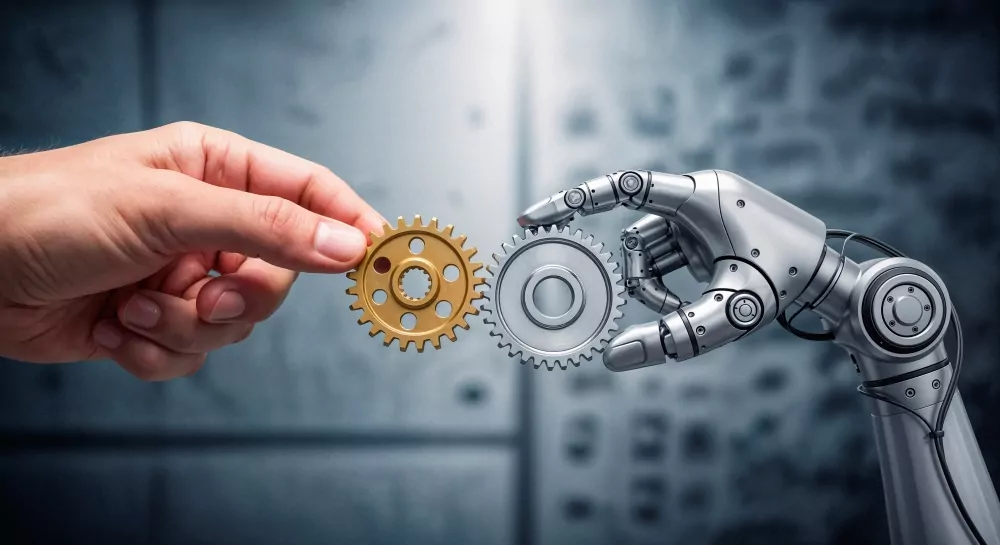
What physical AI means in 2026
Physical AI means artificial intelligence that can sense the real world, make decisions, and act through hardware. It powers machines that move: robot arms, autonomous vehicles, surgical systems, warehouse robots, inspection rigs, and agricultural equipment.
The key difference is timing. When a machine has to brake, grasp, steer, avoid an obstacle, or stop before causing damage, it cannot wait for a cloud server to respond. The decision loop has to run at the edge, close to the sensors, compute hardware, and actuators.
Physical AI is already showing up in:
- Mobile and humanoid robots
- Autonomous vehicles and self-driving platforms
- Industrial inspection systems with computer vision
- Smart machines on production lines
- Surgical robotics and agricultural equipment
- Edge-AI systems built around NPUs, system-on-modules, or MCU-plus-NPU architectures

That makes physical AI more than a model problem. It is a full hardware, software, safety, and validation challenge.
Physical AI vs traditional AI, embedded AI, and robotics
Traditional AI can often tolerate delay because it works with text, images, logs, or offline datasets. Physical AI cannot, because its output becomes a physical action: a motor turns, a brake engages, a gripper closes, or a machine changes direction.
That difference changes the entire engineering stack. Power draw, thermal limits, real-time inference, fault recovery, safety logic, and field validation all become core design constraints from the start.
| Category | What it does | Where compute runs | How it is tested |
| Traditional AI / generative AI | Produces text, images, labels, code, or analysis | Cloud often works | Offline benchmarks |
| Embedded AI | Learns actions in simulated or physical environments | Edge or local simulation | Edge or local simulation |
| Robotics | Controls motors, joints, sensors, and movement | Edge required | Real-world failure testing |
| Physical AI | Senses, decides, and acts through hardware in real time | Edge required | Full sense-decide-act validation |
Robotics and embodied AI overlap with physical AI, but physical AI puts more weight on the complete product build. That includes sensor selection, edge compute, carrier-board design, actuator control, safety logic, and validation before the system reaches the field.
The core loop: sense, decide, act
Every physical AI system runs on the same basic loop: it senses the world, decides what to do, and acts through hardware. The hard part is keeping that loop fast, stable, and safe in real conditions, where dust, glare, vibration, heat, power drops, sensor noise, and people can all interfere with the system.
The engineering stack usually breaks into three layers:
- Sense: Cameras, depth sensors, LiDAR, IMUs, force sensors, torque sensors, microphones, and ultrasonic sensors collect information from the environment. The real challenge is keeping that data calibrated, synchronized, and usable outside the lab.
- Decide: Edge AI hardware runs the model or control policy locally. Teams have to balance compute power, memory, I/O, boot time, latency, heat, and real-world throughput instead of relying only on headline performance numbers.
- Act: Decisions become motion through planners, control loops, motor drivers, servos, steppers, BLDC motors, pneumatics, brakes, relays, or safety interlocks. This is where software output becomes mechanical consequence.

Cloud AI can still support training, simulation, analytics, and fleet learning. But the real-time control loop has to stay close to the machine.
How physical AI systems are trained
Training a physical AI system starts before the prototype is ready for the field. Teams usually combine real sensor data, synthetic data, simulation, teleoperation logs, actuator logs, and failure cases to teach the system how to behave before it faces uncontrolled environments.
Simulation is useful because it lets teams test rare or dangerous scenarios without risking people or hardware. Falls, collisions, bad lighting, unstable payloads, unusual surfaces, and blocked sensors can all be tested before the system is deployed.
Useful training inputs include:
- Camera, depth, and LiDAR data
- Teleoperation logs showing how humans correct the machine
- Annotated images and synthetic scenes
- Motor, gripper, steering, and actuator logs
- Failure cases from field or lab testing
- Simulation runs with changing friction, lighting, payload, and sensor noise
Simulation still has limits. For physical AI, realistic physics often matters more than perfect visuals because the machine has to deal with cable drag, backlash, heat, vibration, latency, and mechanical wear that are hard to reproduce exactly in software.
For founders mapping out a new product, our hardware engineering services are a good place to start.
Where physical AI is already being built
Physical AI is already visible in systems where edge AI has to close the loop faster than a network can respond. These are machines that do not just analyze information; they use sensors, local compute, and control systems to move safely in the real world.
Examples include:
- Waymo’s autonomous driving platform: Uses cameras, LiDAR, radar, and onboard software to perceive the road, plan motion, and control the vehicle in real time.
- Boston Dynamics Spot: A mobile robot used for autonomous inspection, hazardous-site work, data capture, and research in environments built for people.
- Intuitive’s da Vinci surgical systems: Robotic surgery platforms where precise instrument control, vision, safety limits, and human-machine interaction are tightly connected.
- John Deere See & Spray: Agricultural equipment that uses computer vision and machine learning to identify weeds and spray only where needed.
- Agility Robotics Digit: A humanoid robot designed for warehouse and logistics workflows, where balance, perception, manipulation, and safe operation around people all matter.
- Industrial inspection and manipulation systems: Factory robots that combine cameras, force sensing, edge compute, and precise motion control to inspect parts, handle materials, or automate repetitive work.

What connects these projects is the same sense-decide-act pipeline. AJProTech’s role in this category is to help turn that pipeline into reliable hardware: choosing the right sensors and edge compute, integrating actuation, managing power and thermal limits, and validating the system before it reaches the field.
FAQ
What is an example of physical AI?
A warehouse mobile robot is a clear example of physical AI. It uses cameras, LiDAR, and motion sensors to understand its surroundings, plans a safe path locally, and sends commands to its motors without waiting for a cloud response.
What are the four types of AI?
The common capability-based taxonomy includes reactive machines, limited memory, theory of mind, and self-aware AI. Physical AI is not a separate “type” in that taxonomy; it is a way of building machines where sensing, decision-making, and physical action work together.
What companies are working on physical AI?
Physical AI is being developed by robotics companies, autonomous vehicle teams, industrial automation firms, chipmakers, AI platform providers, and research labs. NVIDIA is often referenced for edge AI and simulation platforms, while companies like Waymo, Boston Dynamics, Intuitive, John Deere, and Agility Robotics show how the technology is applied in real machines.
How is physical AI different from embodied AI?
Embodied AI focuses on intelligence inside a physical agent, such as a robot or simulated body. Physical AI goes further into the full product system: sensors, edge compute, power, controls, actuators, safety, validation, and manufacturing constraints.
How do robots learn through interaction?
Robots often start by learning from human demonstrations, such as teleoperation, and then improve through imitation learning, reinforcement learning, simulation, and real-world testing. Simulation helps scale training, but field failures reveal problems that clean virtual environments miss, such as friction, glare, backlash, vibration, and timing errors.
What hardware do you need to get started with physical AI?
Start with the task, then choose the sensors, edge compute, power system, actuation hardware, and safety components needed to close the sense-decide-act loop. At AJProTech, we usually recommend validating feasibility first, before investing in custom PCB, enclosure, or production design.