



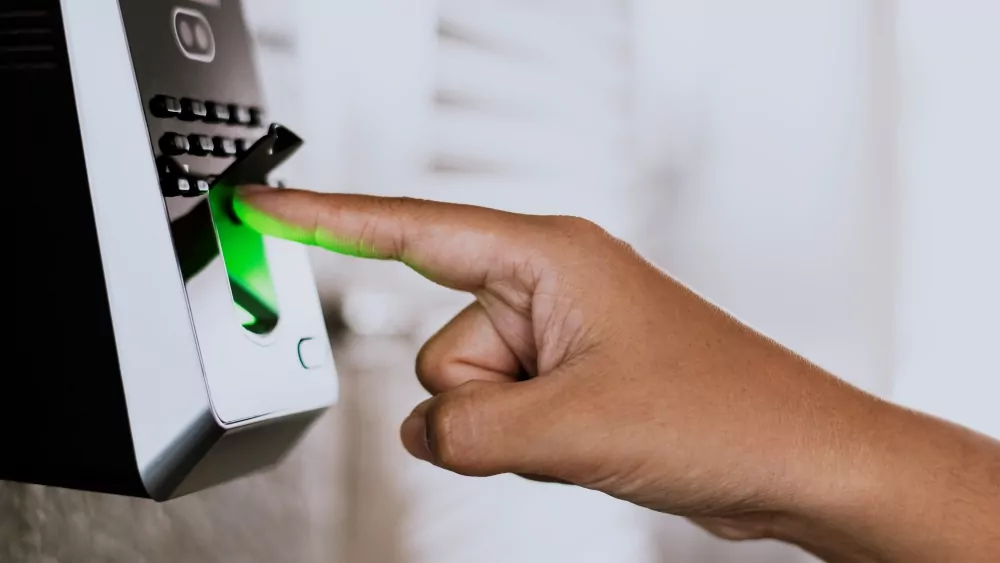
Biometric Authentication for Secure Hardware
Biometric authentication verifies a person by comparing a live physical or behavioral trait against a stored biometric template. In hardware products, the real work is not just the sensor. It is the full capture-to-decision pipeline.
A typical biometric flow includes:
- Capture: The sensor reads a fingerprint, face, iris, vein, voice, or behavioral signal.
- Quality check: Firmware rejects noisy, blurred, partial, or poorly lit samples.
- Feature extraction: Software converts the capture into a mathematical representation.
- Template handling: The device creates or retrieves a protected reference template.
- Matching: The live sample is compared against the stored template.
- Decision: A threshold determines whether access is approved, rejected, or sent to fallback authentication.
The device should store a protected template, not a raw fingerprint image, face photo, iris image, or voice recording. If biometric authentication is treated as a simple UI feature instead of a security architecture, weak points appear quickly.
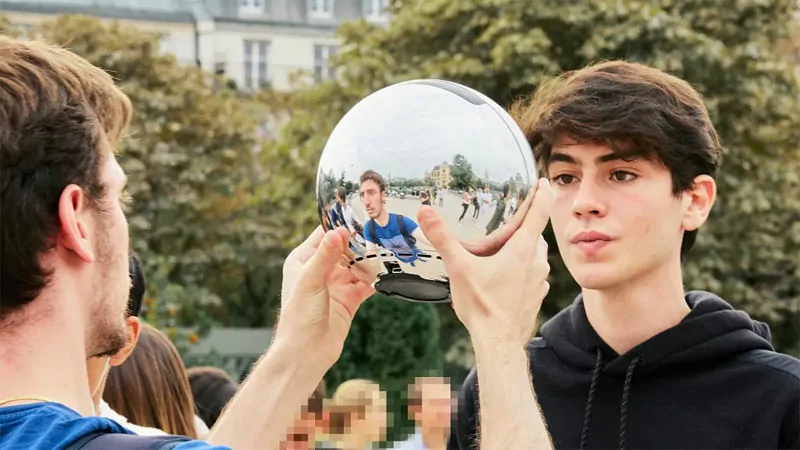
Different biometric methods create different hardware requirements:
| Method | Main hardware requirement | Real example of technology |
| Capacitive fingerprint | Capacitive sensing array and analog front end. | Apple Touch ID in iPhone, iPad, and Mac devices. |
| Optical fingerprint | Illumination, imaging sensor, and image processing. | HID DigitalPersona 4500 optical USB fingerprint reader for desktop and POS identity verification. |
| Ultrasonic fingerprint | Acoustic transducer path and signal processing. | Qualcomm 3D Sonic Sensor used for ultrasonic in-display fingerprint authentication. |
| 2D face recognition | Standard camera and visible-light imaging. | Camera-based facial authentication terminals for access control and attendance systems. |
| 3D face recognition / ToF | Depth sensor, active illumination, and calibration. | Apple Face ID with TrueDepth camera, infrared imaging, and depth mapping. |
| Iris scan | Near-infrared illumination, optics, and eye-safe design. | Worldcoin Orb, an AJProTech-selected work project using eye-based biometric identification. |
| Voice biometric authentication | Microphone path, noise reduction, and anti-replay checks. | Microsoft Azure Speaker Recognition for voice verification and speaker identification. |
| Vein recognition | Near-infrared imaging path. | Fujitsu PalmSecure palm-vein authentication for secure access and financial-sector use cases. |
The right modality depends on the real capture environment. Gloves, dust, masks, bright sun, loud rooms, vibration, moisture, and cleaning chemicals can make one biometric method practical and another unreliable.
Security Architecture, Liveness, and Template Protection
Presentation attack detection, or PAD, helps catch fake samples such as printed faces, replayed videos, molded fingerprints, injected camera feeds, recorded voices, or synthetic speech. PAD is not a single add-on algorithm. It depends on sensor choice, illumination, firmware timing, and matching logic.
PAD usually falls into two groups:
- Passive liveness: The system analyzes texture, reflectance, depth, motion, or signal behavior without asking the user to do anything.
- Active liveness: The system asks for a blink, gaze shift, spoken phrase, pressure change, or other challenge-response action.
The matching architecture also matters:
| Architecture | Where matching happens | Main upside | Main risk |
| On-device | Inside the endpoint or protected local subsystem. | Better privacy, low latency, and offline operation. | Endpoint security must be strong. |
| Server-side | In a backend after sample upload. | Easier centralized policy control. | Larger breach impact and higher privacy exposure. |
| Hybrid | Local checks with server-assisted workflows. | Useful for managed enrollment or regulated flows. | More interfaces and more failure points. |
For most products, on-device matching is the safer default because biometric templates stay local. Centralized biometric databases create a larger failure domain and higher compliance exposure. For the rest of the device stack, the same principle applies in our guide on how to secure IoT devices.
Template storage should sit inside a protected boundary:
- Plain MCU storage: Lowest cost, but weak isolation if firmware is compromised.
- TEE or TrustZone-style partitioning: Better isolation inside the main processor, but still requires disciplined design.
- Secure element: Stronger boundary for protected templates, keys, and restricted operations.
Secure boot, signed firmware, rollback protection, locked debug access, and protected updates belong in the same security chain. A good sensor does not compensate for weak firmware, exposed debug ports, or templates stored in ordinary flash.

Biometric performance metrics also need context:
- FAR: False acceptance rate, or how often an impostor is accepted.
- FRR: False rejection rate, or how often a legitimate user is rejected.
- EER: Equal error rate, where FAR and FRR are equal.
A low FAR on a datasheet does not guarantee strong field performance. Teams should ask how the metric was tested, what population was used, whether spoof attacks were included, and whether conditions match the real product environment.
Product Planning and AJProTech’s Role
Biometric authentication appears in products where local trust matters: access control, fintech devices, medical hardware, industrial equipment, controlled storage, workforce identity systems, and specialized security products.
Common product categories include:
- Access control: Door readers, locks, cabinets, lockers, and padlocks.
- Fintech and payment hardware: Local verification before releasing a credential or signing key.
- Medical devices: Operator identity, controlled access, and patient-linked workflows.
- Industrial equipment: Authentication before maintenance or high-risk actions.
- Enrollment stations: Controlled capture for identity proofing workflows.
Before sourcing biometric hardware, product teams should define the security and product architecture first.
Key questions include:
- Which biometric modality fits the use case: fingerprint, face, iris, vein, voice, or multimodal?
- What capture conditions will the product face in the field?
- What spoof attacks should PAD and liveness checks address?
- Will matching happen on-device, server-side, or in a hybrid flow?
- Where will templates be stored: MCU flash, TEE, or secure element?
- What FAR, FRR, privacy, and retention requirements apply to this product?
Biometric authentication makes hardware development harder because small physical decisions affect both security and usability. Sensor placement, optics, acoustic paths, cover materials, firmware behavior, and storage architecture all change the final result.
AJProTech helps teams design secure biometric, access-control, fintech, medical, and industrial hardware from concept to production. The company’s hardware engineering expertise supports modality selection, sensor integration, secure hardware architecture, firmware planning, prototype validation, and production readiness so biometric security is built into the product early, not repaired after prototypes are already made.
FAQ
How do I enable biometric authentication?
For a product team, enabling biometric authentication means adding enrollment, live capture, feature extraction, protected template storage, liveness checks, matching policy, fallback authentication, and audit behavior. On a consumer device, the user usually turns it on in security settings after registering a fingerprint, face, or similar trait.
Can I use my phone as a biometric device?
Yes, a phone can act as a biometric device when its sensor stack, secure storage, operating system APIs, and application flow support local authentication. In stronger enterprise designs, the phone should use the biometric match to release a cryptographic credential rather than send reusable biometric data elsewhere.
What are the downsides of biometric authentication?
The main downsides are spoofing risk, false rejection, poor enrollment, sensor wear, privacy exposure, and the fact that biometric traits cannot be reset like passwords. Those risks become manageable only when liveness detection, template protection, fallback policy, and data minimization are built into the product from the start.
What is multimodal biometric authentication?
Multimodal biometric authentication combines two or more biometric factors, such as fingerprint plus face or iris plus face. It can improve confidence and reduce simple spoofing, but it also increases hardware cost, power use, enrollment friction, testing scope, and privacy obligations for the product team.
Do MFA platforms support biometric authentication?
Many MFA platforms support biometric authentication indirectly by letting a local biometric match release a passkey, device certificate, secure token, or other cryptographic credential. The platform usually should not receive raw biometric data. What matters most is where matching happens and what gets released after success.
MFA apps, hardware keys, or biometrics: which is more secure?
They solve different parts of the problem. MFA apps depend on device and account security, hardware keys provide strong possession-based protection, and biometrics verify local user presence or identity. In our work, the strongest design is often a biometric check that releases a protected key instead of replacing possession-based authentication.
Passwords vs biometrics: which one is stronger?
Neither is universally stronger because they fail in different ways. Passwords can be changed, but they are phishable and reusable. Biometrics are convenient and harder to share, but they are immutable if exposed. A stronger architecture uses biometrics to release a cryptographic credential, with recovery handled through separate controls.