

How Does Knowledge Distillation Improve AI Models on Edge Devices
Knowledge distillation trains a smaller student model to imitate a larger teacher model. The goal is to preserve useful task performance while reducing memory use, latency, power consumption, and thermal load.
For edge AI products, that can determine whether a model runs on a compact processor, NPU, or even a microcontroller instead of requiring heavier hardware.
Knowledge distillation is only one compression method:
| Problem | Method | Typical benefit |
| Model is too large or slow | Knowledge distillation | Can reduce model size, compute, or latency by roughly 2–10× in favorable cases. |
| Memory or storage is the main limit | Quantization | Often reduces parameter storage by 2–4×. |
| Network contains redundant weights or channels | Pruning | Removes unnecessary parts of the model. |
| Architecture is poorly suited to the hardware | Neural architecture search | Finds a better accuracy-to-compute trade-off. |
| Runtime overhead is high | Operator fusion | Combines supported operations to reduce execution overhead. |
These techniques can also be combined. A common approach is to distill a smaller student model first, then quantize it and test the result on the target hardware.
Choose the Model Around the Hardware
Picking a processor from a peak TOPS (teraoperations per second) number alone is risky. A model can still fail because it needs too much RAM, uses unsupported operators, or spends more time on image conversion and data movement than on inference.
Before locking the chip, PCB, and BOM, teams should measure:
- Required accuracy and response time.
- Input resolution or sequence length.
- Peak RAM and model storage.
- Full application latency, including preprocessing and post-processing.
- Average power consumption and battery target.
- Thermal behavior during continuous operation.
- Runtime and accelerator support for the exported model.
Training performance is not enough. The student model still has to survive conversion, compilation, memory planning, and execution on the actual target device.
A practical deployment flow is:
- Train or select the teacher model.
- Train a smaller student around the hardware budget.
- Validate it with product-like sensor data.
- Export it to the intended runtime.
- Check operator and quantization support.
- Profile the complete application on the real hardware.
| Unsupported operations are a common problem. One layer falling back from an NPU to the CPU can remove much of the expected latency or power advantage. |
AJProTech uses feasibility studies to evaluate model size, runtime support, memory, power, accelerator choice, and BOM constraints before hardware architecture is locked.
Where Distillation Works and Where It Can Fail
Knowledge distillation does not guarantee that a smaller model will behave exactly like the teacher. A student with too little capacity may lose performance on rare classes, ambiguous inputs, or fine details even when headline accuracy still looks acceptable.
Common failure modes include:
- Rare classes and poorly represented edge cases.
- Different cameras, lighting, mounting positions, or field environments.
- Sensor noise, motion blur, or preprocessing changes.
- Teacher errors being transferred to the student.
- A student architecture that is simply too small.
- Unsupported or quantized operators falling back to the CPU.
The best approach is to optimize against the actual product bottleneck. Use distillation when model capacity is the problem, quantization when memory or arithmetic cost dominates, and different architectures when the original network is a poor fit for the device.
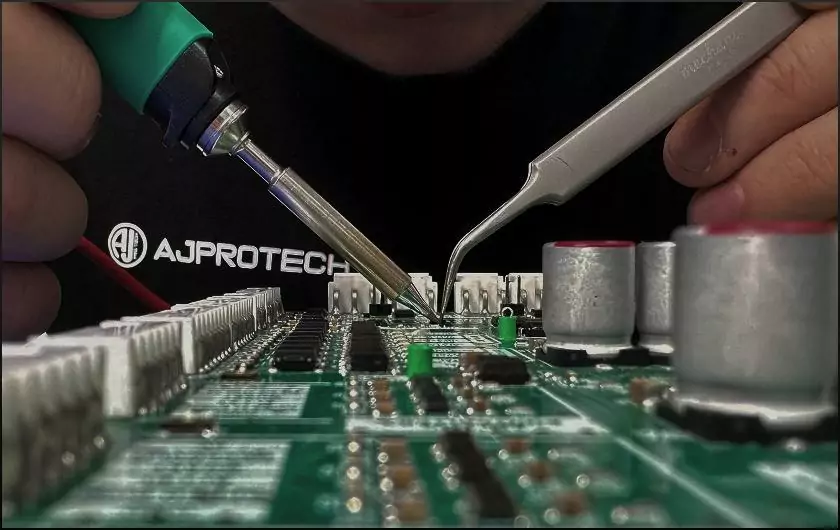
For edge AI products, model optimization and hardware selection should be treated as one engineering problem. AJProTech helps teams connect the model, runtime, accelerator, power system, and product architecture so performance decisions are validated on the device, not only on a workstation.
FAQ
Is knowledge distillation the same as transfer learning?
No. Transfer learning adapts an existing model to a new task or dataset. Knowledge distillation trains a smaller student model to reproduce the behavior of a larger teacher.
Should you use distillation or quantization first?
For many edge products, distillation comes first and quantization follows. The final choice should still be based on device profiling and runtime support.
Can knowledge distillation help AI run on microcontrollers?
Yes, in some cases. But the model still has to fit the device’s RAM, flash, runtime, and energy budget. Very constrained systems may need distillation, quantization, and a simpler model architecture together.
How much can knowledge distillation reduce a model?
In favorable cases, model size, compute, or latency can improve by roughly 2–10×, but the result depends heavily on the model, task, dataset, and hardware runtime. For more specifics, consult AI hardware development experts at AJProTech.