




Premium hunting smartwatch for life off the grid
BRIDGER WATCH
Category
Wearables
Consumer Electronics

Awards

Services
Feasibility Study
Industrial Design
Mechanical Design
Hardware Development
Firmware Development
Software Development
Prototyping
Design for Manufacturing
2023 - 2025
The Challenge
Deep in the backcountry, every second of focus counts. Checking your route, tracking your position, and staying oriented through dense terrain all demand tools that work as fast as you think. Phones lose signal, drain battery in the cold, and stay buried in a pack when you need them most. A detailed topographic map on your wrist gives you a reliable second source you can check without breaking stride, so you're never depending on one device alone.
Our client understood this problem firsthand. He hunted backcountry and needed a watch capable of displaying rich topographic maps accurate enough to trust in the field. After surveying everything available, the conclusion was clear: nothing on the smart watch market addressed this specific need. Mapping capabilities across existing outdoor watches were too limited for real backcountry navigation.
The Opportunity
The Bridger team had a clear vision: a watch that could display the detailed topographic maps hunters rely on worldwide in the field. The kind that show elevation changes, drainage patterns, and terrain features accurate enough to navigate by. The starting point was simple: find an existing platform capable of running that experience and build on top of it.
That platform did not exist. The companies building watches with real mapping capability were not interested in opening their hardware to outside development.

The Solution
With no suitable platform available, we developed the hardware from the ground up. A purpose-built outdoor watch with offline topographic mapping, onX Hunt integration, waypoint navigation, and real-time terrain data, designed specifically for hunters who demand reliable navigation in serious backcountry.
From the start, the design intent was clear: a smartwatch the user would actually want to wear everywhere. Tough enough for a week in the backcountry, Sharp enough for a business meeting, and refined enough for a gala. Water- and dust-resistant, with 2+ weeks of battery life, it follows one simple rule: your watch should never be the reason you have to turn back.


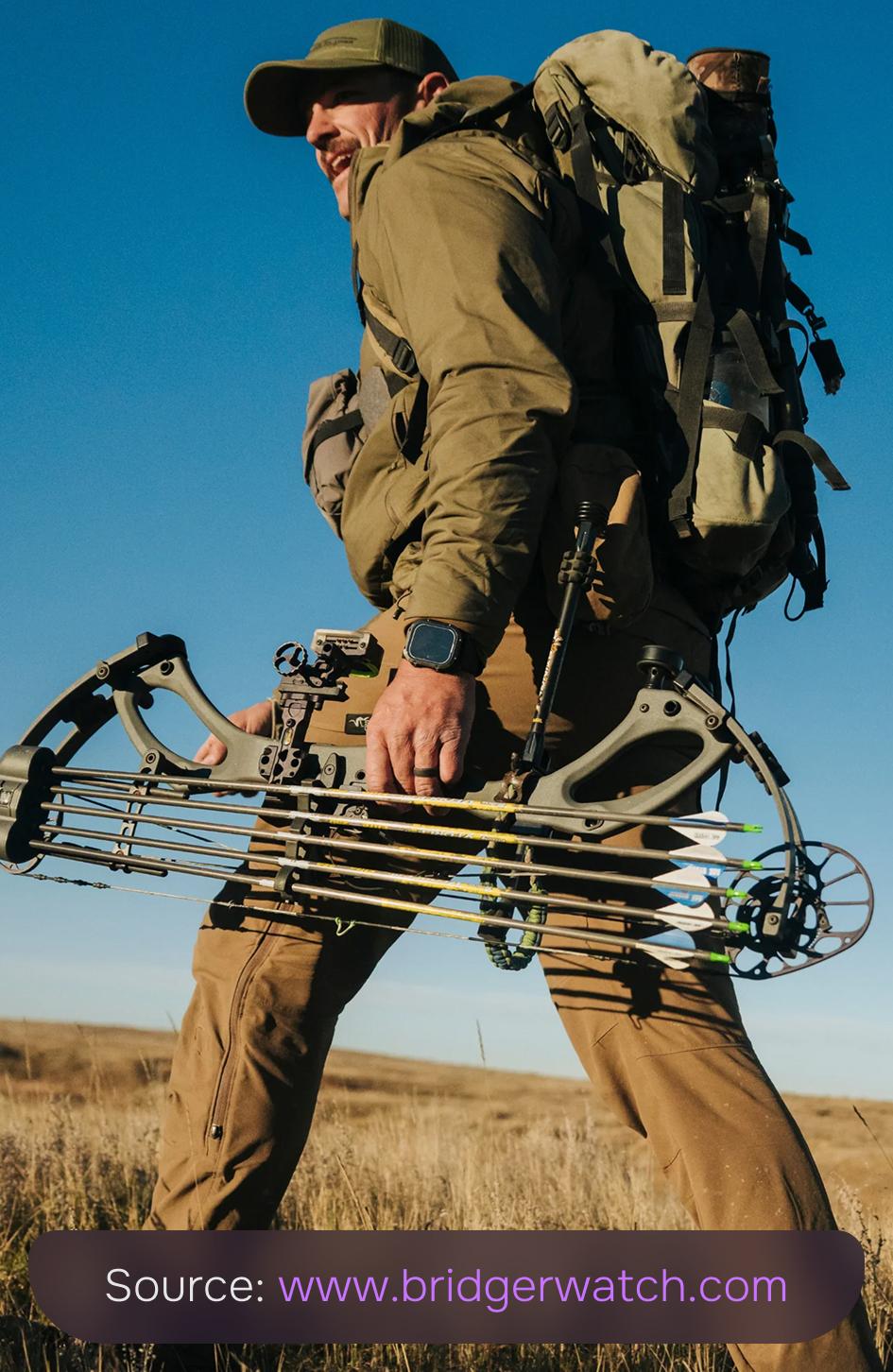
The device was built for outdoor enthusiasts who spend real time in the field. Hunters, hikers, and backcountry adventurers get a rugged, capable companion with features chosen specifically for their use.
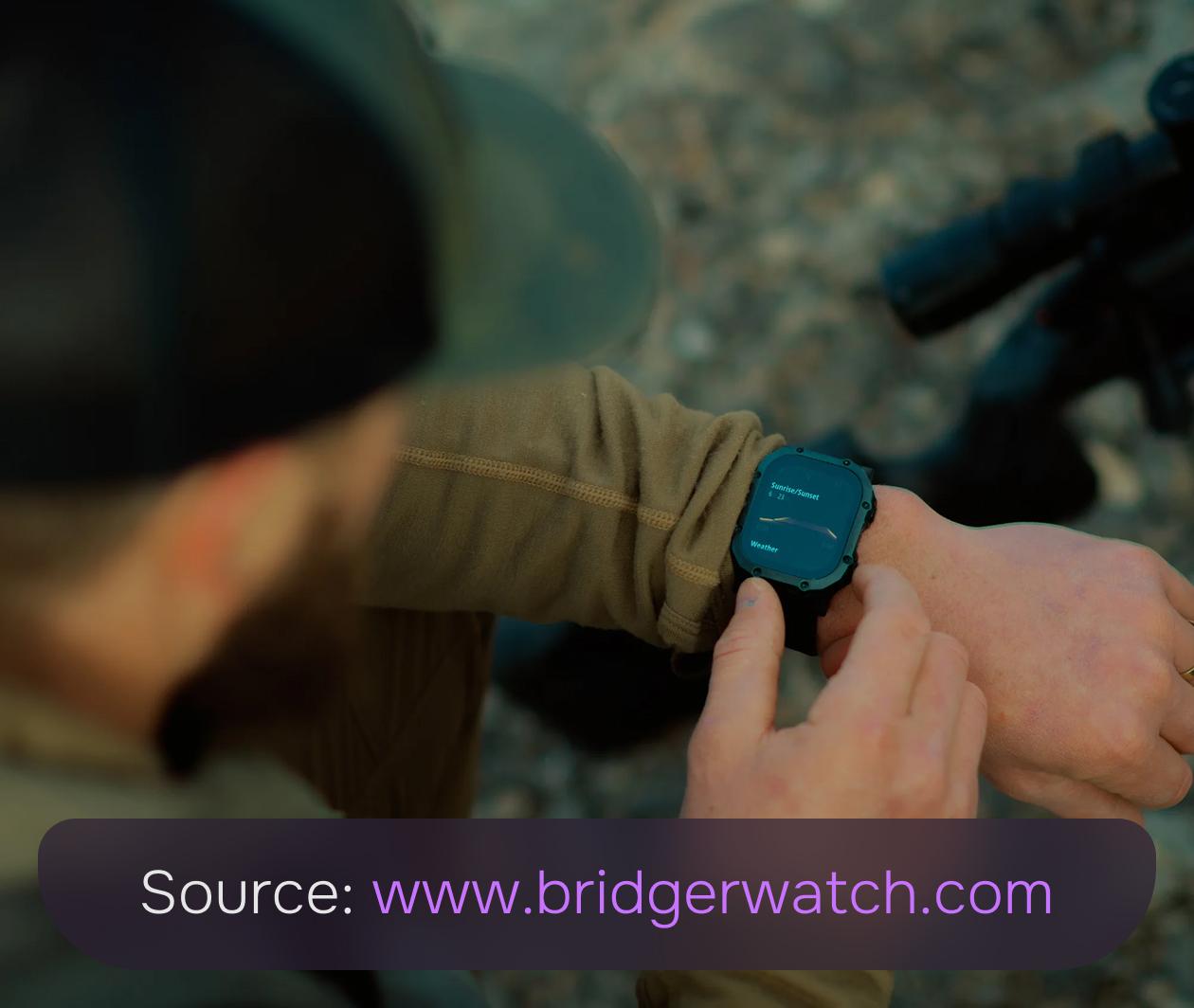
- Offline topographic and satellite maps load the moment you raise your wrist
- Color-coded waypoints and real-time tracking confident navigation in any terrain
- Large offline map downloads supported for areas without cell coverage
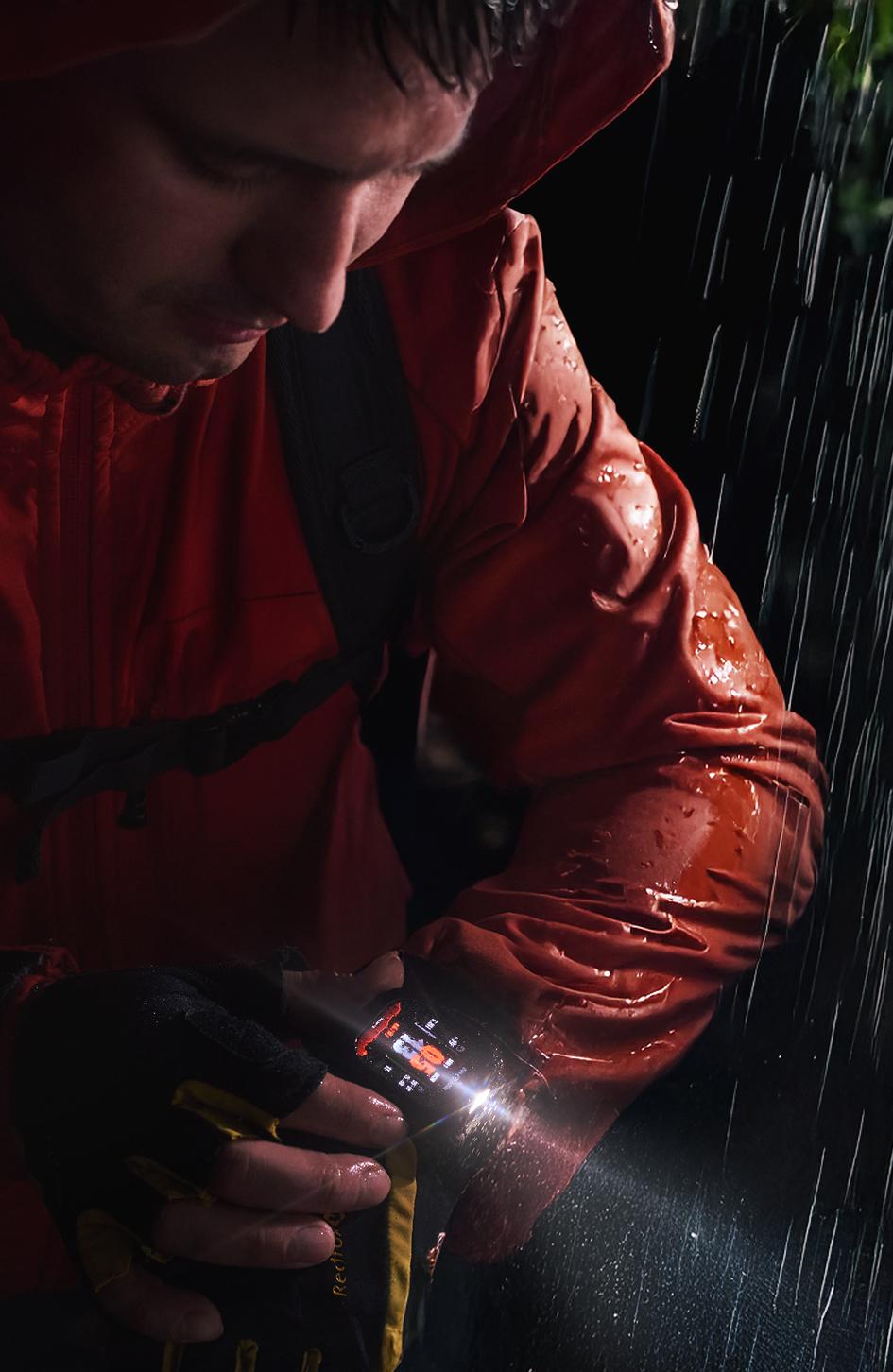
- Built-in dual-color LED flashlight for low-light conditions in the field
- VO2 max tracking, sleep monitoring, and daily goal-setting for year-round use
Some of the best engineers and wearable developers in the world - people who have created products you’ve probably worn - believed in our vision and jumped in to help.
So yes, our founding crew consists of hunters through and through, but behind the scenes, we have top-tier tech talent working to bring this vision to life.
Industrial Design
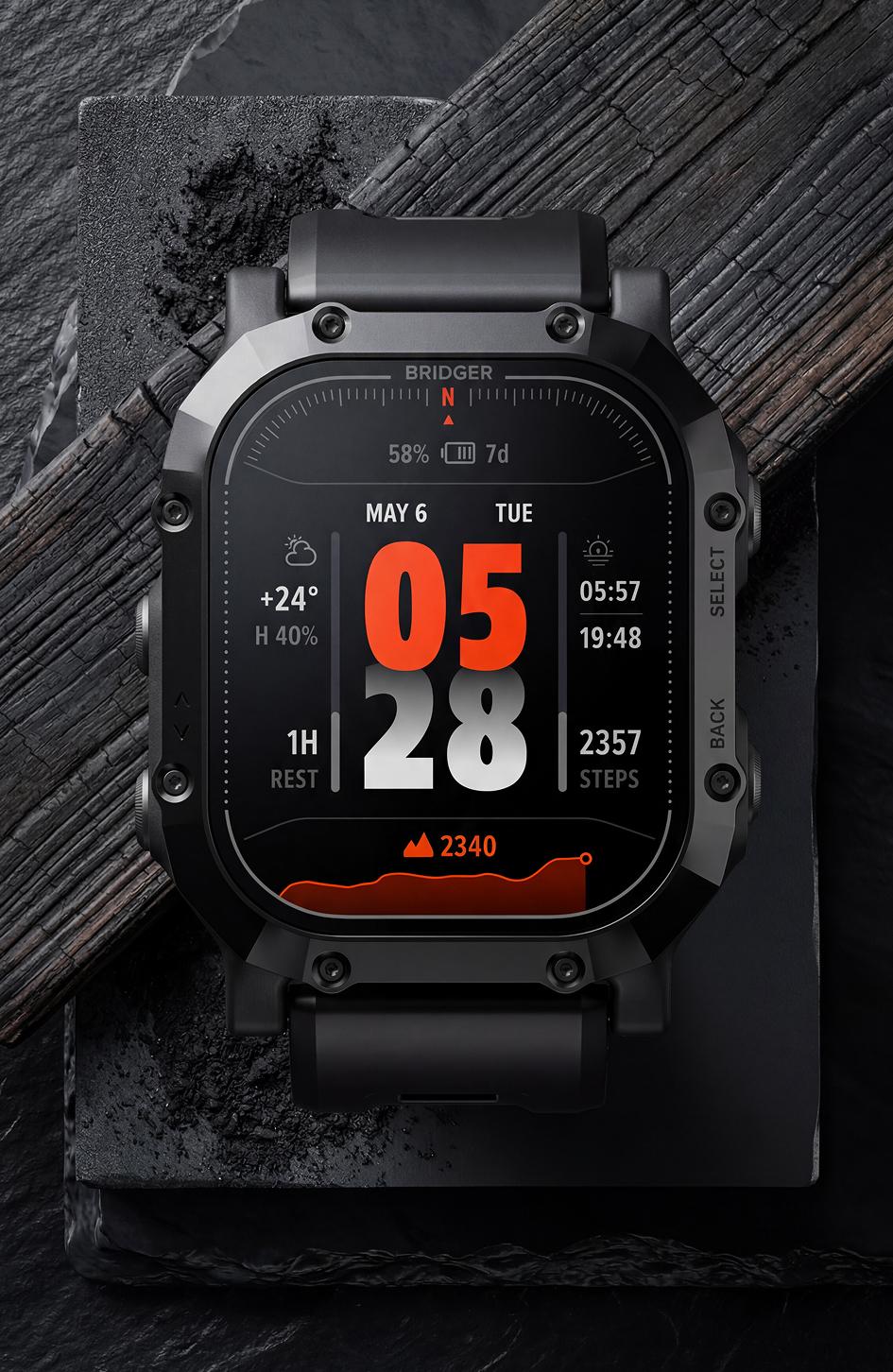
The Bridger was designed for hunters who need gear they can trust. Every proportion, material, and surface detail was driven by what that user needs in the field. The result is a watch that works everywhere else too: at the range, at the table, on a training run, without looking out of place in any of them.
The brief demanded a design that reads as powerful from the first glance. Rugged enough for a week in the field, considered enough to wear anywhere else.
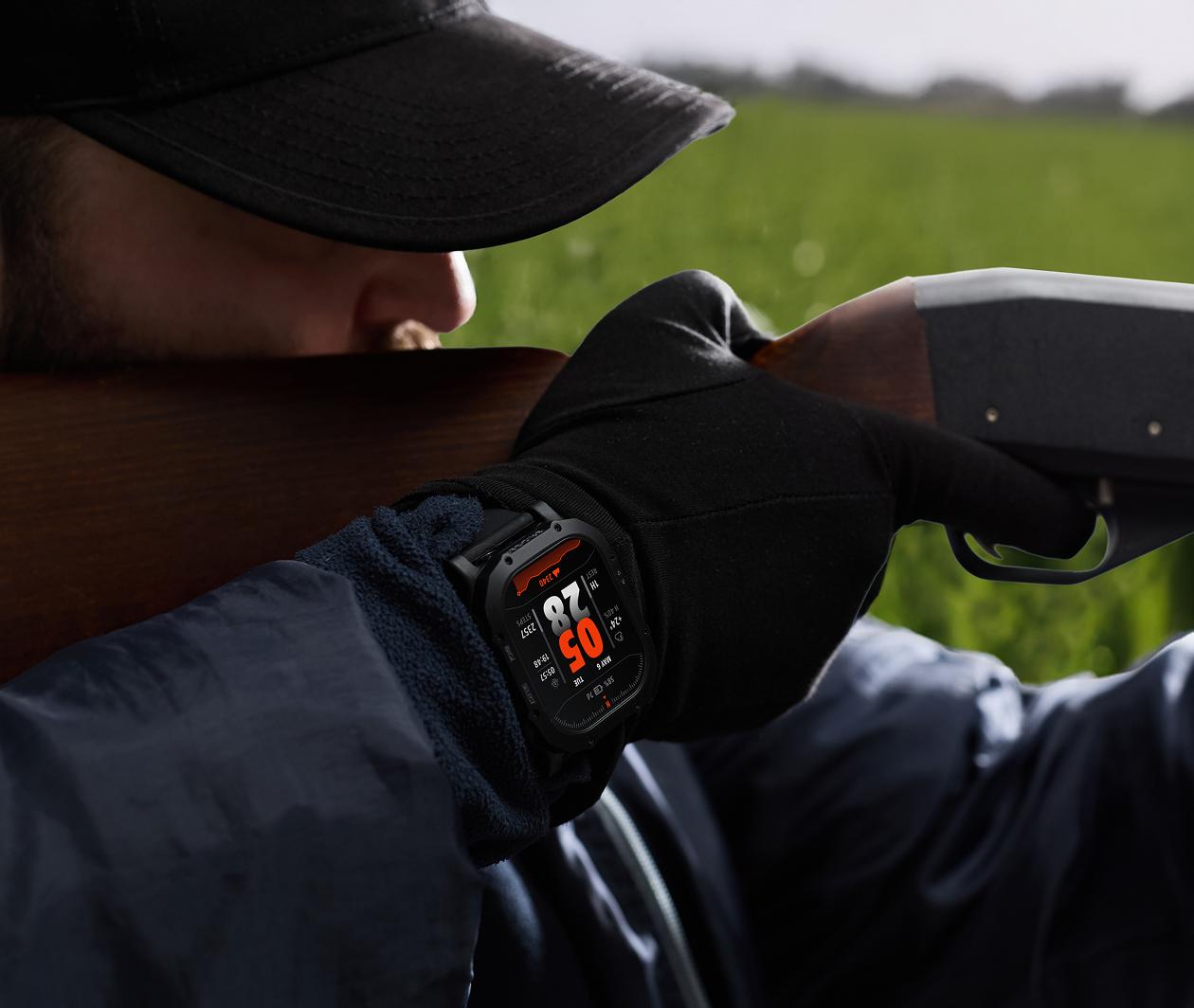
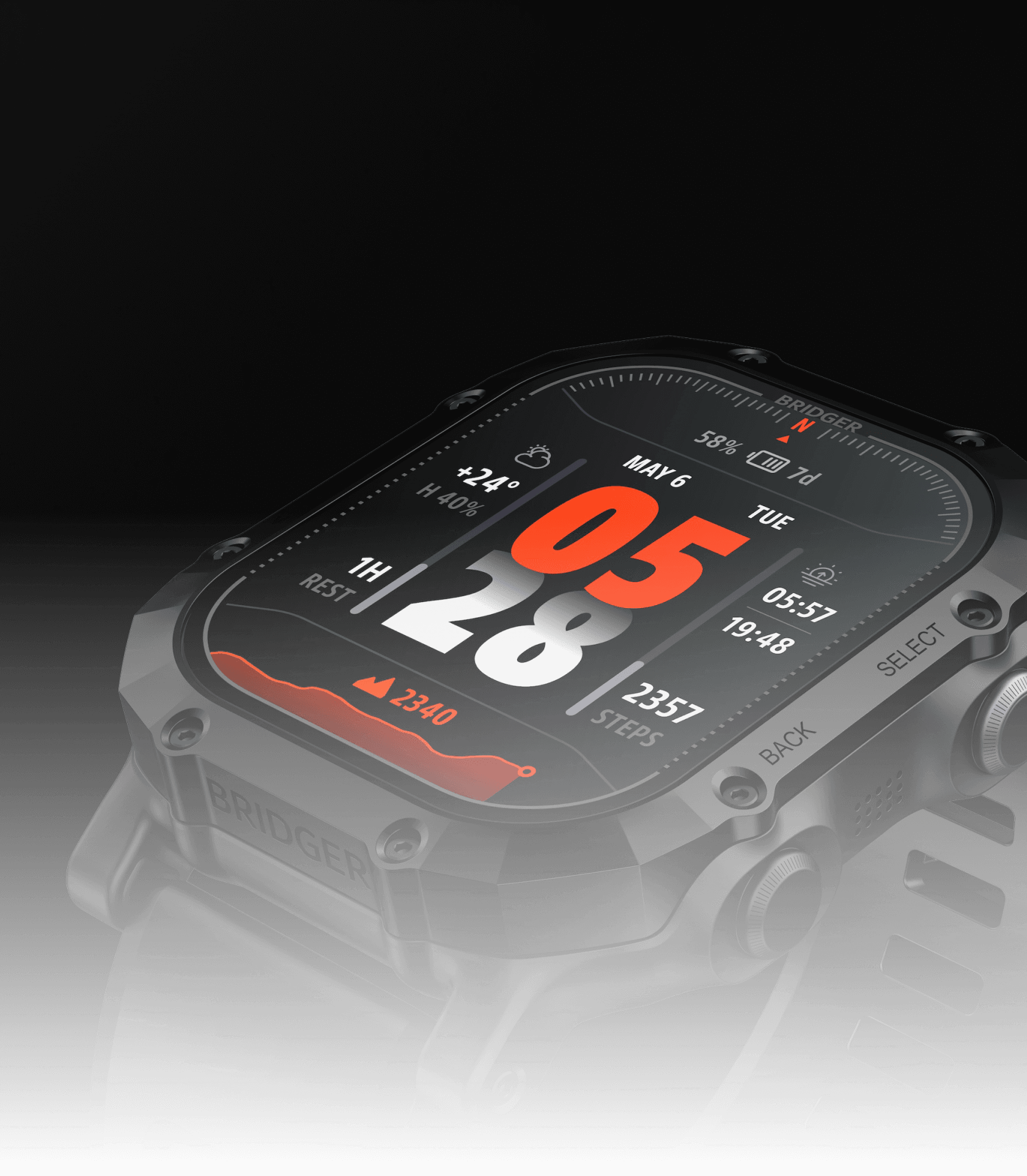
The form factor decision came early. We evaluated round, square, and rectangular layouts against one primary requirement: mapping. The rectangle won on every count. It maximizes screen real estate and allows topographic lines, waypoints, and route overlays to render edge to edge. That same geometry is what makes the Bridger readable in direct sunlight, with gloves on, at a glance.

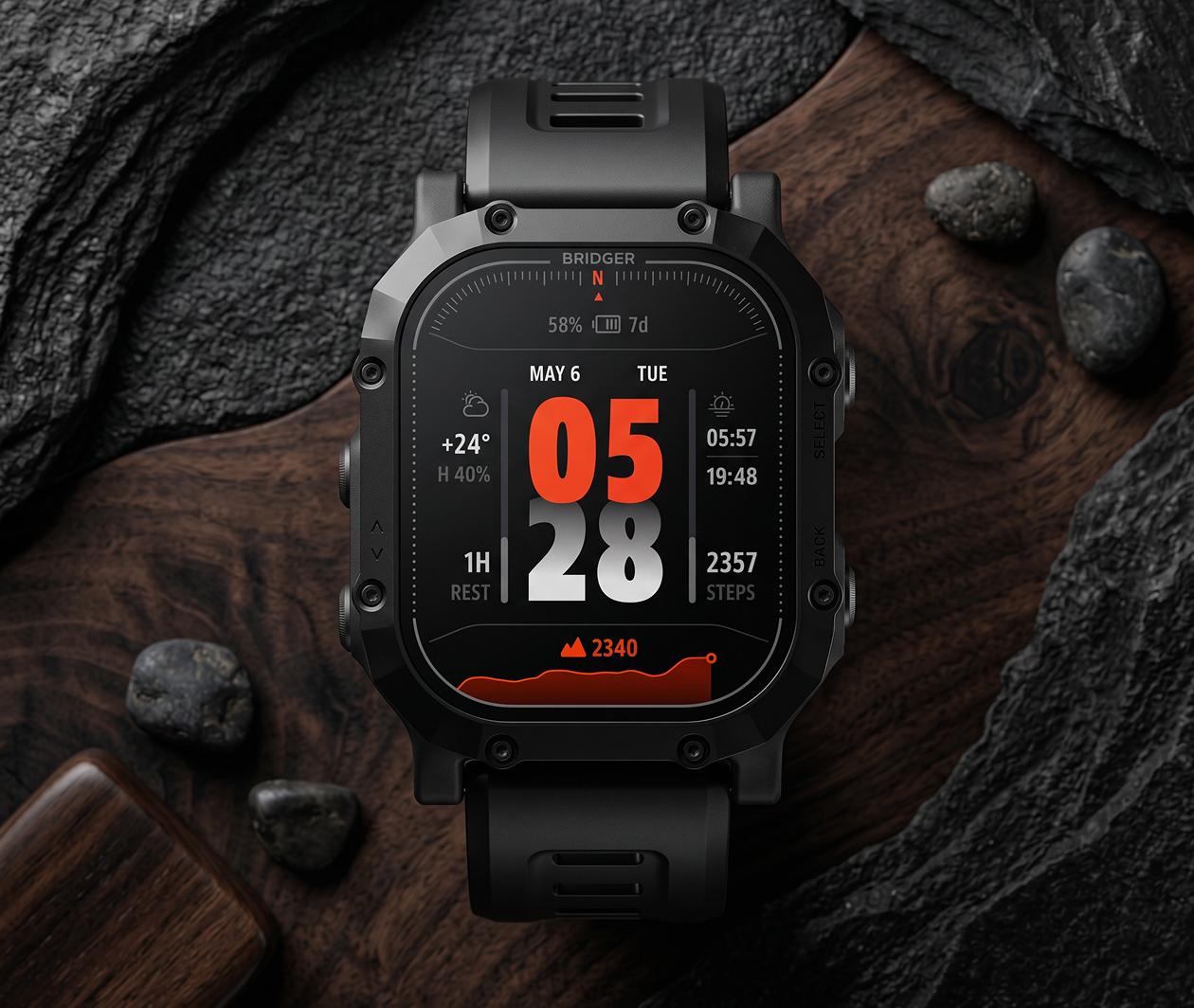
The materials reinforce that intent. Titanium, sapphire crystal glass, exposed hardware, and a case profile substantial enough to signal precision without adding unnecessary bulk. Every surface detail was chosen to communicate the same thing: this is a tool built to perform.
Building a wearable?
Talk to the team behind Bridger Watch
Schedule a call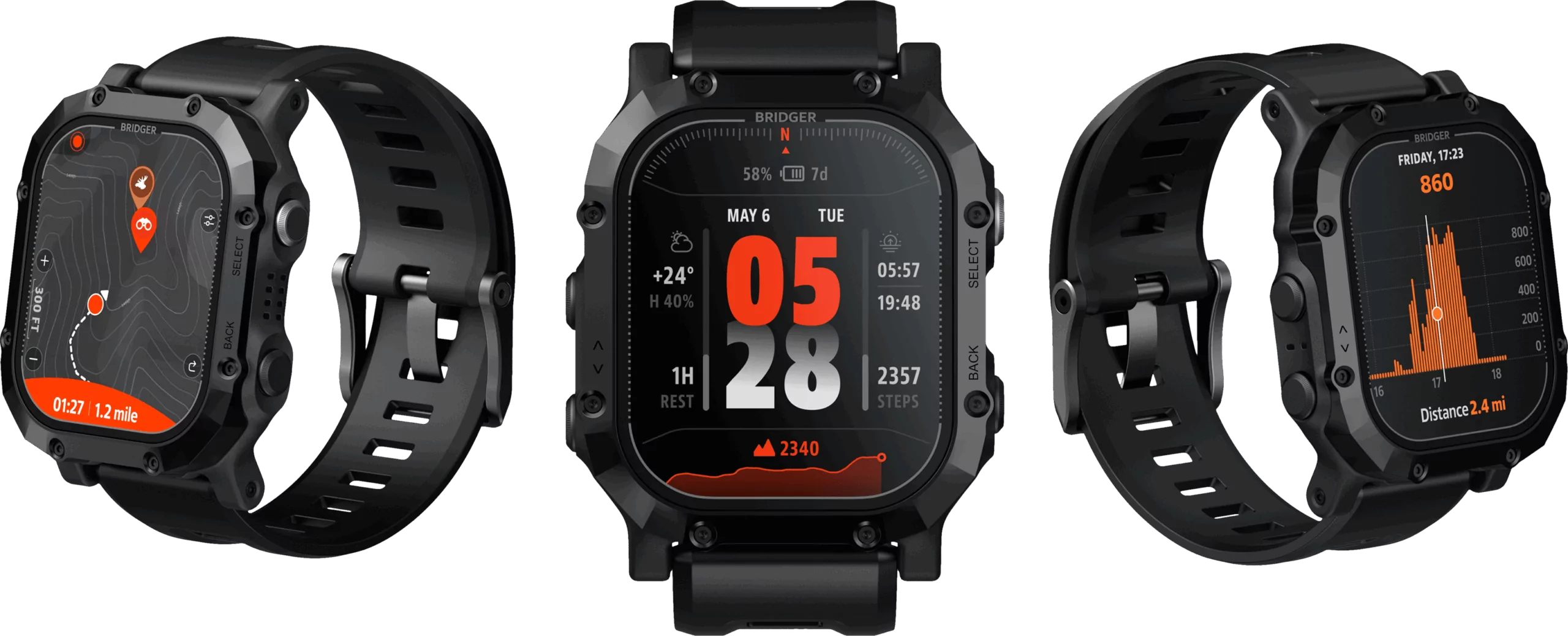
Designing Bridger's form factor was determined by understanding use-case requirements, several rounds of prototyping, user-testing and rigorous DFM cycles - through sketching, CAD, physical mock-ups and strong team communications, a unique silhouette was established with the client, engineering teams & suppliers coordination.
Bridger Watch leverages uncompromising, robust materials like a faceted titanium bezel, sapphire glass, exposed screws and gasketed mid-line, for water proofing - to withstand extreme conditions, unpredictable terrains & environmental topography.
Resolving this highly specialized design required harmonizing functional, manufacturable and scalable solutions to co-exist with nature and hyper specific user-needs. By embracing the outdoors, this carefully crafted design offers a solution that feels natural to use and performs at all costs.

Navigation & Mapping
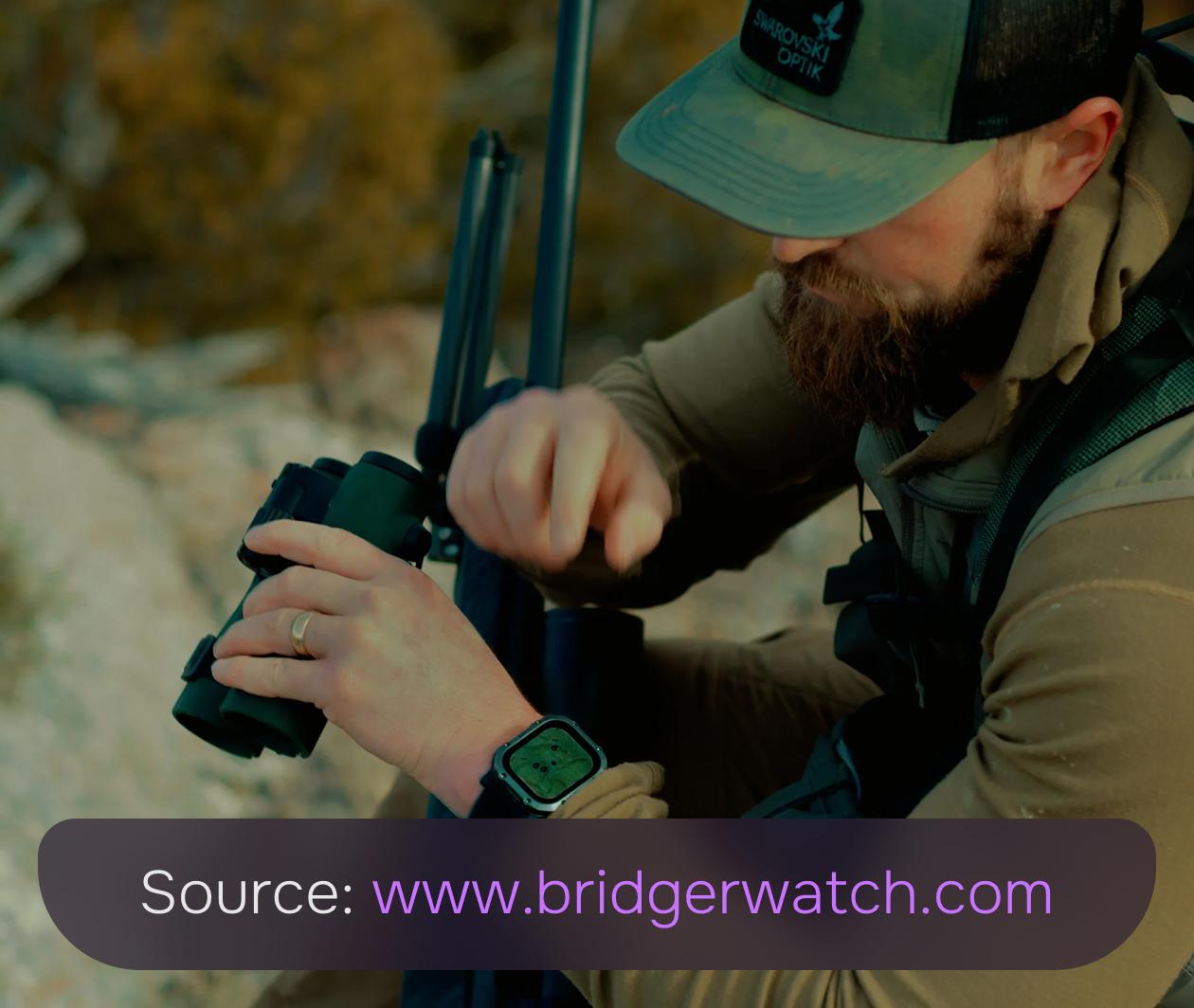
Mapping was meant to be Bridger's standout feature and everything else was built around it. Detailed topographic maps rendered in full resolution, available whether you have signal or not. Bridger stores the maps directly on the device, so the level of detail doesn't drop when you lose connection deep in the backcountry. You get the same trail contours, elevation lines, and terrain features on the wrist whether you're standing in town or miles from the nearest tower.
The team built an offline mapping engine from the ground up. Maps download to the watch and render instantly. Waypoints, tracks, and route data sync directly from the companion app. And because hunters already live in onX Hunt, we built the integration in. Every point and track they have spent years building transfers directly to the watch.


The interface was designed around how hunters actually navigate in the field. Every core function is accessible without the touchscreen, operable with gloves on, in the dark, under pressure. Waypoints drop without digging through menus. The map responds the way a hunter already thinks about terrain.
The Bridger integrates directly with onX Hunt, the mapping platform hunters already rely on. Saved areas, waypoints, and markups transfer from the app to the watch in seconds, bringing years of accumulated field knowledge onto the wrist.
Mechanical Design
The case is built from titanium and fiber-reinforced polymer, with sapphire crystal glass and PVD coating. Titanium was chosen for a specific combination of properties: it is lighter than steel, harder than most alloys, and fully corrosion-resistant in the conditions Bridger is built for. A reinforced sealing architecture with precision-fitted gaskets delivers 10 ATM water resistance, engineered to hold under submersion and pressure changes at elevation.

Fitting a dual-band GNSS antenna, display module, battery, and full sensor array inside a wearable profile was a core structural challenge. The rectangular form factor introduced additional complexity around corner stress and drop resistance. Internal shock-absorption geometry was integrated directly into the chassis to protect critical components without compromising the clean exterior lines.
Design and mechanics went through dozens of prototyping iterations, using 3D printing and CNC machining to test and refine the geometry, then producing custom titanium samples to validate the final design for manufacturing.


Button placement and tactile response received dedicated attention throughout development. Every physical control had to be actionable with cold hands, in the dark, under stress. A built-in dual-color LED flashlight, switchable between white and red, was integrated directly into the case and accessible from the wrist without reaching for a phone or separate light source. Interchangeable 26mm quick-connect silicone straps complete the assembly, keeping the watch firmly in place regardless of conditions.


Electrical Engineering
At the core of the Bridger is a tightly integrated electronics stack built to deliver flagship-grade performance in a compact form factor. Fitting a multi-band GNSS module, a full sensor array, a 600+ mAh battery, and a 1.97" AMOLED display into a case slim enough for all-day wear was the central engineering challenge.
Development began with a full-size validation board: a larger PCB carrying all core components in an accessible layout, purpose-built for testing and debugging every major function before miniaturization began. Once the architecture was proven, the board was redesigned down to the final watch-scale form factor.


Optical Sensor Module
Heart rate and SpO2 tracking called for a custom optical sensor module, since standard off-the-shelf options didn't meet the accuracy Bridger needed for outdoor use. We partnered with a top-tier optical sensor chip supplier and designed a custom module around their sensor, then shrank it down to fit the watch's compact form factor.


UI Development
We started with active research, spending hours on competitive teardown work: watching extensive video reviews of existing smartwatches, mapping common user flows, and studying content from athletes, hunters, and outdoor users describing how they actually use their watches in the field. This gave us a clear picture of the strengths and weaknesses of devices already on the market, and the foundation to build something unique, perfectly suited to Bridger's customers..
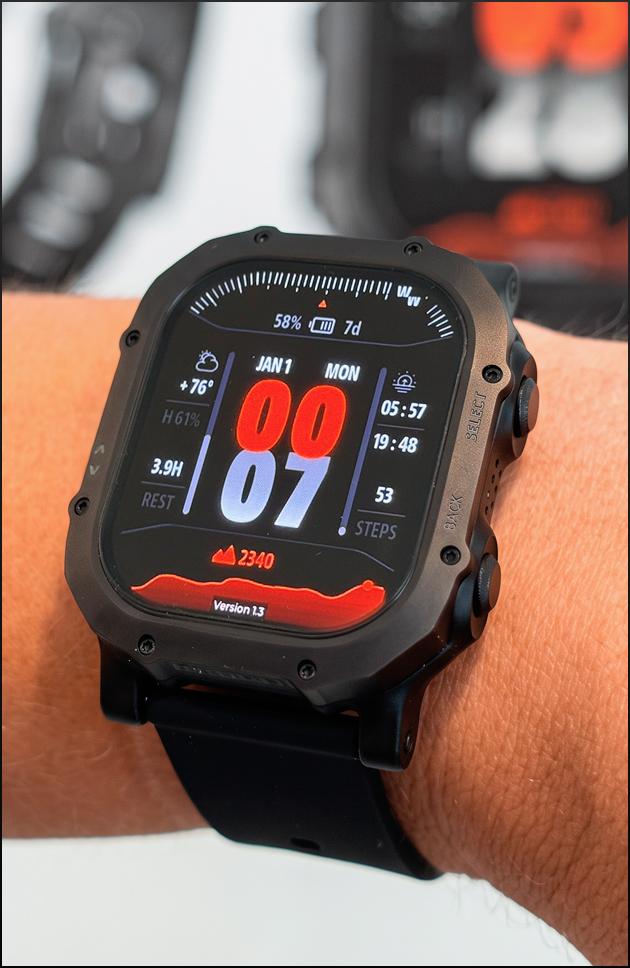
A core requirement was that every function remain accessible without the touchscreen. Field conditions such as rain, gloves, and cold hands make touch input unreliable, so every core action works through physical buttons.

One piece of the visual identity we're particularly proud of is the activity and workout icon set: a modular system of squared-headed figures rooted in Otl Aicher's pictogram work for the 1972 Munich Olympics.
The UI was kept intentionally restrained. A black-dominant color scheme reduces display power draw, which extends battery life in the field. Every screen was designed to carry only what the user needs in that moment.
Firmware Development
Custom RTOS
The Bridger runs on custom software built from scratch, alongside the hardware itself. The team designed the Operating System and the Printed Circuit Board together, side by side. The Bridger's software was built for its exact hardware, by the same team, at the same time. That is what allows the watch to manage GPS power intelligently, load maps instantly, and behave predictably in conditions where other devices fall short.
Battery life is Bridger's superpower. Most smartwatches, Android included, need a charge every day or two. Bridger runs for 2+ weeks, thanks to a software decision the team made early on: building a custom operating system on Zephyr instead of shipping whatever came off the shelf.
For the user, that decision shows up in the details. Battery life is managed at the architecture level, so the watch knows when to use GPS and when to conserve power without losing position. Every sensor, every interaction, and every screen transition behaves the way a hunter in the field needs it to, because the team that built the hardware also built the software that runs on it.
Battery life by design
The watch uses motion data to determine when GPS is actually needed. When movement is steady and predictable, the GPS module powers down and position continues to update from the accelerometer alone. That single decision accounts for a significant portion of the battery life improvement over standard always-on GPS operation.
Stable wireless connectivity
WiFi, Bluetooth, GPS stability was validated through a dedicated internal test application built specifically for that purpose. It allowed the team to catch data integrity issues early, well before integration with the companion app.
Over-the-air updates
Firmware updates are delivered wirelessly through the watch interface or the companion app. For a watch used deep in the field, reliable updates without cables or docks were a design requirement built in from the start.
WHAT CAN WE CREATE TOGETHER?
Schedule a Free ConsultationPrototyping
Iterative Development
Firmware development started on an evaluation kit. The display PCB connected with flex cable, giving the team direct access to all peripheral buses and debug interfaces without committing to a custom board layout early. Display drivers, UI rendering, and sensor communication protocols were all validated at this stage.
When the core firmware was stable, the electronics moved into a standalone external module. It ran as a self-contained system but stayed accessible for probing and firmware flashing. That configuration handled wrist-worn testing, long-duration battery profiling, and early UI feedback.
From there, the board was redesigned to fit inside the Bridger enclosure, with the full feature set, production housing geometry, physical button layout, and power management all working together.

Development kits

Proof of concept

Engineering prototype
Production-Grade Prototyping
The team moved to production-grade materials: polymer housing and titanium bezel. With the complete electronics package integrated into the enclosure, the watch could be evaluated as a whole unit: durability, thermal performance, assembly sequence, and structural integrity.


The validated prototype was then transferred to the factory to begin DFM review ahead of mass production.

Mass Production
Prototyping is where core engineering problems are solved. Every dimension, material, tolerance, and assembly sequence had been validated through the prototyping process before a single production file left our hands.
We handed off the engineering package to the ODM manufacturer for final DFM and production preparation: Bill of Materials, CAD files, CMF specifications, Electronics and Firmware base. ODM takes the product across finish line to bring it to manufacturing.
The Bridger Watch is now in full production. Available for purchase at bridgerwatch.com.


Impact
- Bridger fills a gap the wearables industry left open for years: a smartwatch built specifically for the outdoor and hunting community, not adapted from a general-purpose platform
- The device earned the iF Design Award for precision engineering, intuitive UX, and industrial design.
- The first production run launched as the Founder Series, a limited serialized batch that sold out and put hardware into the hands of real users ahead of the next production run.

Let's Talk About Your Project
Please fill out the form and we'll get back to you shortly
Our Case Studies



Contact Us
Headquarters: Los Angeles, CA
26565 Agoura Road, Suite 200,
Calabasas, CA 91302
R&D and Manufacturing
New Taipei City
Wenhua 2 Road, Linkou District
Software design
Almaty