



Small language models and large language models both process natural language, but they solve different product problems. LLMs offer broader reasoning and stronger general-purpose performance. SLMs focus on speed, privacy, and efficient deployment.
| Factor | Small Language Models | Large Language Models |
| Best for | Focused tasks, on-device assistants, private document tools, voice commands, and workflow automation. | Complex reasoning, long-form generation, code, research, and broad open-domain tasks. |
| Deployment | They can run locally on phones, laptops, embedded systems, and edge devices. | They usually run in the cloud or on powerful local servers. |
| Resource needs | They need less memory, less power, and fewer compute resources. | They need strong GPUs, large memory, and cloud-scale infrastructure. |
| Latency | They can respond quickly because there is no cloud round trip. | They may introduce delay because requests often travel to remote servers. |
| Privacy | Sensitive data can stay on the device. | Data often leaves the device unless a private cloud or local server is used. |
| Cost model | They can reduce per-request or per-token costs after deployment. | They can create ongoing cloud inference costs. |
| Main limitation | They may struggle with deep reasoning, long context, and complex multi-step tasks. | They are expensive to run and harder to deploy on edge hardware. |
In short, LLMs are the stronger choice when maximum capability matters. SLMs are often better when the product needs fast, private, cost-efficient AI close to the user.
How SLMs and LLMs Power Edge Devices
Small language models make real-time AI possible on edge devices such as phones, laptops, wearables, smart speakers, and field equipment.
LLMs usually rely on cloud infrastructure. This works well for advanced tasks, but it adds latency, network dependence, and recurring compute costs. SLMs can run locally, which makes them useful when speed, privacy, or offline access matters.
On-device SLMs are especially useful for:
- Voice command systems that need instant responses.
- Offline copilots for field teams and remote workers.
- Private document assistants for legal, healthcare, and enterprise users.
- Instant translation tools that work without sending speech to the cloud.
- Embedded AI features where latency and cost must stay low.
Deployment still requires planning. Teams must check memory, storage, NPU performance, battery impact, and model size before choosing an on-device language model.

At AJProTech, we usually recommend a feasibility check before committing to edge SLM deployment. As a rough starting point, devices with at least 2GB RAM and 1–5 TOPS of NPU performance may support compact models such as Phi-2, Llama-mini, or Gemma for focused real-time tasks.
The practical rule is simple: use cloud LLMs when the task needs broad reasoning and maximum capability. Use SLMs when the product needs fast, private, offline, and cost-efficient AI on the device.
Commercial Value of SLMs: Why and When to Choose On-Device SLMs
For founders, the key question is not only how capable a model is. The real question is whether it can run on the target device at the right cost, speed, and power level.
Small language models are designed for this constraint. Models such as Phi, Gemma, and compact Llama variants can support focused language tasks on devices with limited RAM, storage, and NPU performance.
On-device SLMs can create strong commercial value because they reduce dependence on cloud infrastructure:
- The product can avoid per-query or per-token API costs.
- User data can stay on the device.
- Responses can be generated with lower latency.
- Devices can keep working offline.
- AI features can scale without cloud bills growing with every user.
A feasibility check should start with the device specification. Teams need to evaluate free RAM, flash storage, NPU or CPU performance, battery limits, and expected token throughput.
As a practical rule, devices with several gigabytes of free RAM and a modern NPU are often strong candidates for focused SLM deployment. If the hardware is weaker, teams can still consider hybrid cloud-edge workflows or more aggressive model compression.

At AJProTech, we recommend validating the model on real hardware before committing to a product roadmap. A model that performs well in the cloud may still fail on-device if memory, latency, or thermal limits are too tight.
Privacy, Offline Capability, and Zero Inference Cost
On-device SLMs are especially valuable when privacy, reliability, and operating cost matter.
Because user data stays local, companies can reduce privacy risks and simplify compliance. This is important for healthcare, legal, finance, enterprise automation, and any product that handles sensitive information.
Offline capability also expands where the product can work. SLMs can support users in remote sites, underground locations, vehicles, factories, or field environments where cloud access is unreliable.
Key advantages include:
- Sensitive prompts and documents can remain on the device.
- AI features can work without a stable internet connection.
- Companies can reduce exposure to cloud outages and network delays.
- Users get faster responses for routine and domain-specific tasks.
- Product owners avoid recurring inference fees for every prompt.
“Zero inference cost” means there is no external API charge after deployment. The model still uses local electricity and device resources, but each prompt does not create a new cloud bill.
For founders, this changes the economics of AI products. The upfront work moves toward hardware optimization, model selection, and deployment. In return, the product can scale with lower recurring AI costs.
Fine-Tuning Small Language Models for Real-World Use
SLMs become more useful when they are tuned for a specific workflow. A general model may answer broad questions, but a fine-tuned SLM can support a focused product feature with better speed and relevance.
Fine-tuning can help with:
- Voice assistants that understand product-specific commands.
- Retail copilots that answer inventory or product questions.
- Field service tools that guide technicians through diagnostics.
- Private document assistants that summarize local files.
- Translation and note-taking tools that work offline.
Teams can use transfer learning, prompt tuning, quantization, and domain-specific datasets to adapt SLMs without making them too large. The goal is to improve task performance while staying within the memory and power limits of the device.
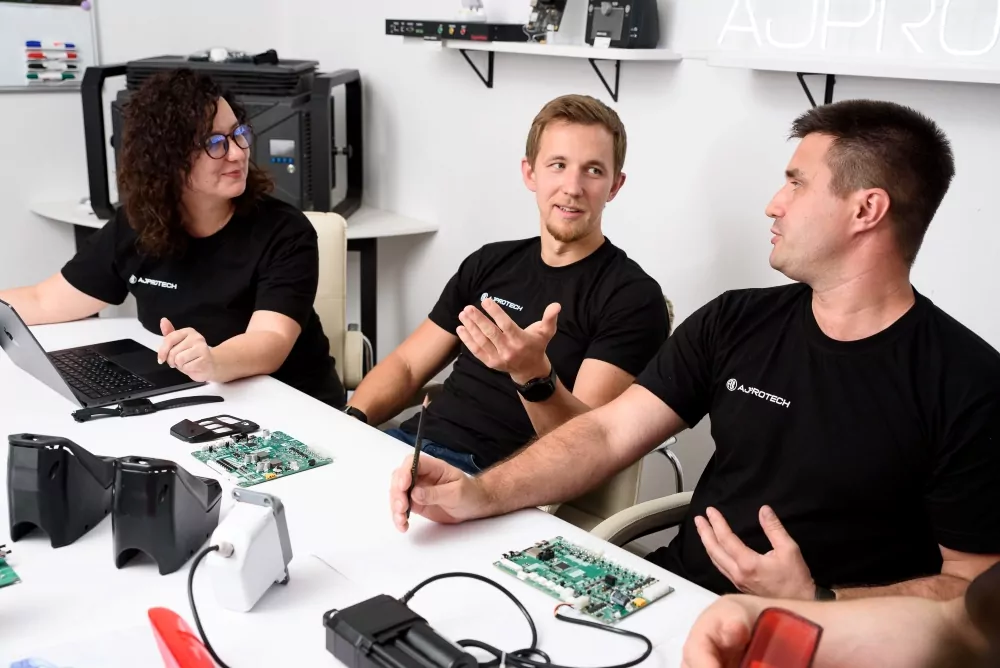
Hardware still defines what is realistic:
- The model must fit available RAM and storage.
- The NPU or CPU must support acceptable response speed.
- Battery impact must be low enough for daily use.
- The device must support model updates after launch.
- The workload must match the model’s context and generation limits.
SLMs are not a replacement for every cloud LLM use case. They are best when the task is narrow, repeated, privacy-sensitive, or latency-critical.
For startups, this is often enough. A well-tuned SLM can turn a device into a private AI assistant, reduce operating costs, and support a faster launch without building a heavy cloud backend.
At AJProTech, we help teams assess whether their hardware can support on-device SLMs and define the integration roadmap before development begins. For an in-depth feasibility study or integration roadmap, have a look at our practical assessment offering.