



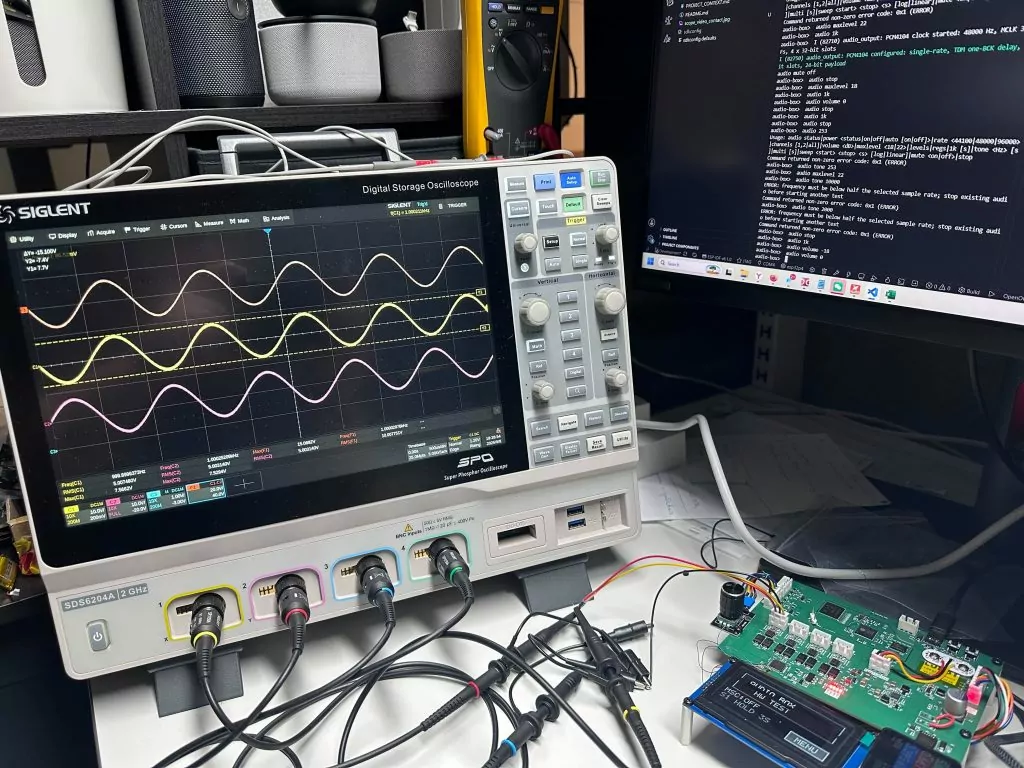
Ultra wideband, or UWB, is a short-range radio technology built for precise ranging. It measures how long radio signals take to travel between devices, allowing distance to be estimated within a few centimeters in favorable conditions. With multiple antennas, it can also determine direction. That makes UWB useful when a product needs more than a simple “nearby” signal.
A smart lock is a good example. Bluetooth can tell the lock that a phone is in range. UWB can help determine whether that phone is outside the door or already inside the hallway. That difference may decide whether the lock should open.

UWB does not replace Bluetooth, Wi-Fi, cellular, NFC, or GNSS. It carries relatively little data. Its main role is to add reliable distance and direction information to products that often use another radio for discovery, pairing, or communication.
UWB vs Bluetooth, NFC, and Wi-Fi RTT
The practical question is not which radio is “best,” but which one matches the interaction your product needs.
| If your product needs to… | Best starting point | Why |
| Know whether a user or device is simply nearby | BLE | Low-power, widely supported, and well suited to discovery and basic proximity. |
| Know precise distance or direction | UWB | Better suited to decisions based on where the device actually is, not just whether a signal is present. |
| Require an intentional tap or very close interaction | NFC | Simple and predictable when the user is expected to bring the device close on purpose. |
| Use existing Wi-Fi infrastructure for indoor positioning | Wi-Fi RTT | Useful where compatible access points are already part of the environment. |
| Improve ranging while staying inside the Bluetooth ecosystem | Bluetooth Channel Sounding | Promising for finer ranging, but support still depends on the device and ecosystem. |
- BLE remains the better choice for low-power discovery and routine data exchange. NFC works well when the interaction should be deliberate.
- Wi-Fi RTT can support positioning where suitable infrastructure already exists.
- UWB becomes valuable when the product must make a decision based on trusted distance or direction.
That distinction matters because BLE RSSI is a poor ruler. A hand over an antenna, a phone in a pocket, or a metal door frame can change signal strength dramatically without the actual distance changing.
Bluetooth Channel Sounding is beginning to narrow that gap with phase-based ranging and round-trip timing, but support is still less universal. UWB remains the stronger choice when precise ranging or direction is central to the product rather than an optional feature.
UWB itself uses several ranging methods:
| Method | How it works | Typical application |
| Two-way ranging | Two devices exchange packets and calculate distance from round-trip time. | Smart locks, wearables, peer-to-peer devices |
| TDoA | Fixed anchors compare when they receive the same transmission. | Warehouses, factories, large tracking deployments |
| Angle of arrival | Multiple antennas measure phase differences to estimate direction. | Direction finding and spatial interfaces |
The right method depends on the product. A lock may only need distance between two devices, while a warehouse tracker may need several anchors to calculate position across an entire building.
Notable Engineering Challenges Behind Reliable UWB
Choosing a UWB module is only the beginning. Real performance depends on antenna placement, enclosure materials, body position, radio scheduling, firmware, and security.
Antenna and enclosure design
UWB performance can change significantly once the radio moves from an open development board into the final product.
Batteries, displays, metal frames, shielding, fasteners, and the human body can all reshape or block the radio path. No ranging algorithm can fully compensate for an antenna placed behind a large battery or next to a metal bezel.
Teams should therefore define the required range, accuracy, direction, and device topology before starting PCB layout.
Key design steps include:
- Reserve antenna volume and keep-out areas early.
- Consider batteries, ground geometry, shielding, displays, and metal parts during RF layout.
- Measure performance inside the actual enclosure.
- Test wearables in several body positions and orientations.
- Test trackers inside pockets, bags, and near metal surfaces.
- Include non-line-of-sight conditions in validation.
- Prototype the antenna and enclosure together before tooling.
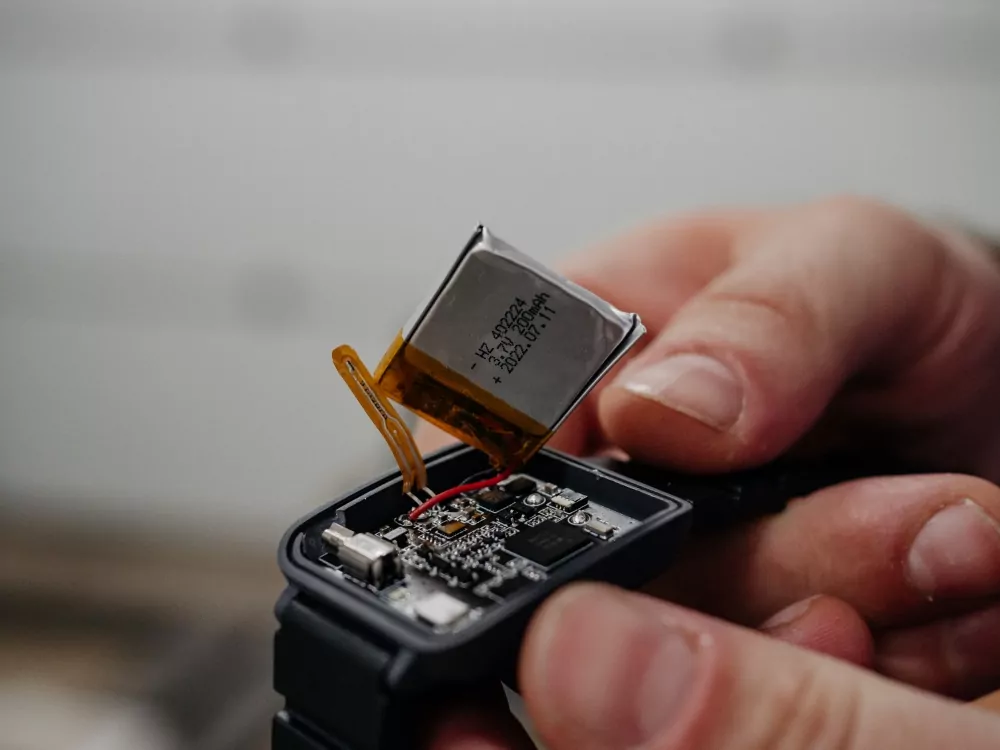
AJProTech has taken connected wearables and tracking devices from development boards through custom PCBs and enclosure integration, including products where wireless performance and positioning are central to the experience. If your first UWB board is heading into an enclosure, our hardware engineering team can review RF, mechanics, and firmware in one pass.
Security and relay attacks
UWB can also improve access-control security because it measures physical distance rather than relying only on the presence of a valid credential.
A relay attacker may forward a key signal from farther away, but cannot make the radio signal travel faster. Secure ranging mechanisms based on IEEE 802.15.4z add additional protection to the timing information used in the distance calculation.
This makes UWB attractive for digital keys and access-control products, but it does not replace the rest of the security architecture.
Products still need:
- Secure authentication.
- Protected key storage.
- Signed firmware updates.
- Safe fallback behavior.
- Clearly defined responses when ranging fails.
A noisy or blocked ranging session is not unusual. The product therefore needs to know whether to retry, deny access, or fall back to another method.
Power and radio scheduling
UWB typically runs in short bursts rather than continuously. In battery-powered products, BLE often performs discovery and wake-up, while UWB activates only when accurate ranging is required. A wearable might switch UWB on only when the user approaches a lock or starts a specific interaction.

Battery consumption therefore depends heavily on:
- How often ranging runs.
- How many retries occur.
- Antenna efficiency.
- Time spent transmitting and receiving.
- How the system wakes and sleeps.
AJProTech treats UWB as a combined RF, mechanical, firmware, security, and power-design problem rather than a standalone radio feature.
When UWB Is Worth Adding to a Product
UWB adds BOM cost, antenna complexity, firmware work, radio certification, calibration, and production testing. It makes sense when accurate position information creates enough value to justify that complexity.
Typical applications include:
- Smart locks that distinguish inside from outside.
- Digital keys that verify physical proximity before unlocking.
- Asset trackers that show both direction and distance.
- Industrial badges that detect entry into hazardous zones.
- AR and VR controllers that need spatial awareness.
- Wearables that react differently depending on where the user is standing.
Sensor fusion can make UWB more useful. An IMU can bridge short periods when the radio path is blocked, while UWB can correct the positional drift that builds up in inertial tracking.
For AI-enabled devices, distance, direction, and zone information can also become model inputs. UWB effectively becomes another spatial sensor that helps the product understand its physical context.
Smartphone support needs separate attention. UWB is increasingly available in flagship devices, but compatibility still varies by model, region, operating system, and supported profile. Having a UWB chip in both devices does not automatically guarantee interoperability.
Before Adding UWB to the Roadmap
Before committing to UWB, work through a few practical questions:
1. Does the product need precise distance or direction, or is basic proximity enough?
Easy answer: “We only need to know whether the user is nearby.”
Course of action: Start with BLE. UWB may add cost and complexity without creating enough product value.
2. Will it communicate with smartphones, dedicated tags, installed anchors, or all three?
Easy answer: “Only with our own dedicated tags.”
Course of action: You control both ends of the system, so interoperability is simpler and the UWB architecture can be optimized around your own hardware.
3. Which interoperability profiles and certifications does the target ecosystem require?
Easy answer: “It must work with supported smartphones.”
Course of action: Check device support, required UWB profiles, and certification requirements before choosing the module or firmware stack.
4. Can the BOM support the additional radio, antenna, calibration, and production test?
Easy answer: “Yes, the product can absorb the extra hardware cost.”
Course of action: Move the discussion from component price to full implementation cost, including RF layout, calibration, validation, and manufacturing test.
5. Has performance been tested with the real enclosure, body position, and non-line-of-sight conditions?
Easy answer: “So far, only on an open development board.”
Course of action: Do not treat the ranging results as final. Test the antenna inside the intended enclosure and in realistic use conditions before tooling.
6. How will UWB work alongside BLE, Wi-Fi, GNSS, IMUs, or other sensors?
Easy answer: “BLE will wake the device, and UWB will handle precise ranging.”
Course of action: Define the radio schedule and responsibilities early so power, firmware, and user interaction are designed as one system.
If your answers to these questions made the architecture clearer, you probably have enough direction to move into feasibility and prototyping. If they made the product more confusing, AJProTech can help you work through the trade-offs and define the right UWB architecture before tooling and production decisions are locked.
FAQ
How accurate is UWB indoors?
In favorable conditions, UWB can achieve accuracy of a few centimeters. In more difficult environments with metal, reflections, body blockage, or poor anchor geometry, accuracy may fall to tens of centimeters.
Can UWB work through walls or the human body?
Partly. Plastic, wood, and fabric may cause limited attenuation, while concrete, metal, and the human body can significantly weaken or block the direct path. Reflections may also make the measured distance appear longer.
Does UWB drain the battery?
It depends mainly on how often it runs. A product that wakes UWB only when precise ranging is needed can keep consumption relatively low. Continuous ranging, repeated failures, and poor antenna placement increase energy use.
Is UWB better than Bluetooth?
Not generally. They solve different problems. BLE is better suited to low-power discovery, communication, and simple proximity. UWB is better when the product needs precise distance or direction. Most real designs use both, which is why the Bluetooth device design decisions still come first.
Is Bluetooth Channel Sounding an alternative to UWB?
It can be for some products. Bluetooth Channel Sounding improves BLE ranging using phase and timing measurements and may suit applications that already depend heavily on Bluetooth. UWB remains attractive when centimeter-level ranging, direction finding, or secure distance measurement is central to the product.
Do UWB products need FiRa certification?
Not always. Regional radio approval is required for market access. FiRa certification becomes more important when the product needs standardized interoperability with smartphones or third-party UWB devices.