



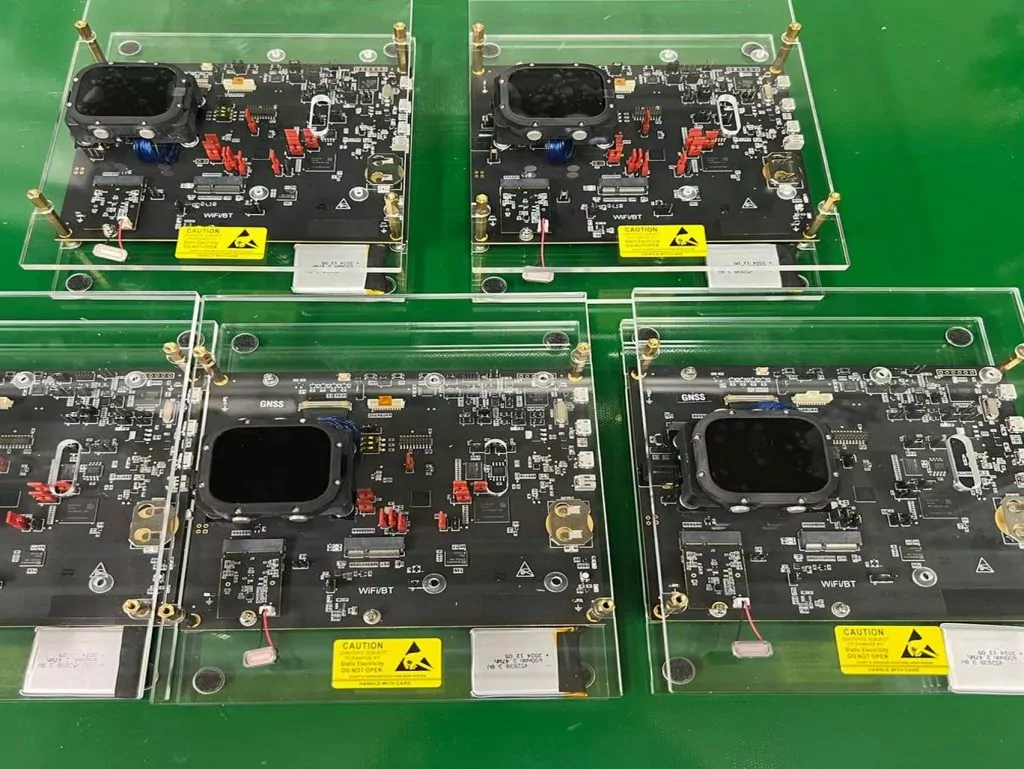
What is the Difference between PoC and Other Prototypes
A hardware proof of concept answers one practical question: can the riskiest part of the product work under realistic conditions?
It is not a smaller version of the final product. A PoC may test whether:
- A sensor can separate useful signals from noise.
- A battery can support the required duty cycle.
- A radio works through the intended enclosure.
- An edge AI model meets latency and power limits.
- A manufacturing method can hold a critical tolerance.
- A target cost looks realistic at the intended volume.
The output should be evidence for a decision: proceed, revise, defer, or stop.

A PoC should also not be confused with later development stages:
| Stage | Main question | Typical output |
| PoC | Can the risky assumption work? | Measured pass/fail evidence. |
| Works-like prototype | Can the main functions work together? | Functional prototype. |
| Looks-like prototype | Does the intended form and interaction work? | Physical design model. |
| EVT | Does the integrated engineering design meet requirements? | Production-intent engineering units. |
A bench demo may prove one idea. It does not automatically prove durability, manufacturability, certification readiness, or production quality.
Define Success Before You Build
A PoC without measurable success criteria can easily become a demonstration that everyone interprets differently.
Instead of saying, “the sensor works,” define a result such as:
The sensor detects the target condition across 30 representative samples with no more than two false positives.
A useful PoC brief should define:
- The assumption being tested.
- What is explicitly out of scope.
- Realistic test conditions.
- The measurements to collect.
- A clear pass/fail threshold.
- Available time, parts, and people.
- Who makes the proceed-or-stop decision.
The build itself should be as simple as possible. Depending on the question, that may mean an evaluation board, 3D-printed fixture, bench rig, subsystem board, or manufacturing sample.

Development kits are useful, but their limits matter. A model that runs on a development board may still consume too much power, overheat in an enclosure, or fail when connected to the real sensor and radio system.
Turn PoC Evidence Into the Next Product Decision
A good PoC leaves behind measurements, test conditions, failed approaches, constraints, and a documented conclusion. Those findings should directly influence the next design stage.
The result may lead the team to:
- Select a different sensor.
- Reduce or remove a feature.
- Change battery or power targets.
- Modify enclosure geometry.
- Reconsider radio architecture.
- Adjust the expected BOM or production approach.
The biggest PoC mistake is scope creep. A team starts by testing one technical question, then adds a mobile app, enclosure, cloud backend, industrial design, and production firmware. At that point, the project has quietly become a prototype program without a clear scope or budget.

A focused PoC may take days or a few weeks. More complex studies involving custom samples, several subsystems, or specialized test conditions can take longer.
| When the uncertainty extends beyond one technical question, AJProTech can expand the work into a feasibility study covering engineering, manufacturing, cost, and product architecture before major development spending begins. |
FAQ
Can a PoC be built without custom electronics?
Yes. Evaluation boards, off-the-shelf modules, temporary firmware, test fixtures, and 3D-printed parts are used often enough if they genuinely test the risky assumption. During rapid prototyping, AJProTech uses focused PoCs to test uncertain technical assumptions before teams commit to custom electronics, tooling, or a larger prototype program.
Who should review PoC results?
Several stakeholders should review the results, but each should focus on a different question:
- Founder or product owner: Does the evidence support continuing to invest in the product, or does the concept need to change?
- Engineering lead: Did the PoC meet its technical success criteria, and what constraints should carry into the next design stage?
- Relevant technical specialist: Are the measurements, test conditions, and conclusions technically credible within that domain?
- Budget or investment decision-maker: Does the result justify the next level of spending on prototyping, tooling, certification, or production?
Is a PoC the same as market research?
No. A PoC asks whether the concept can work technically. Market research asks whether customers understand, want, or will pay for it.
Do you need a PRD before starting a PoC?
Usually not. A short brief defining the problem, scope, test method, resources, and success criteria is enough. The results should then feed into the later product requirements document.
When should a team skip the PoC?
If the product uses proven technology with little technical uncertainty, the team may move directly into requirements and prototyping. A PoC is most valuable when one uncertain assumption could invalidate the entire product.