


You can’t bolt intelligence onto a product after the fact. You have to decide, from the very first schematic, where thinking happens, and why.
For early-stage hardware teams, this question shapes everything: the chip you specify, the privacy story you tell users, the operating cost at scale, and whether your product still works when the internet goes down. Getting this right from the start saves months of expensive rework later.
This article walks through edge AI and cloud AI clearly, compares them honestly, and gives you a practical framework for deciding what belongs where in your product.
Start with one question: how much time does your product have?
Before choosing a chip, a framework, or a cloud provider, ask this: when your device needs to make a decision, how long can it wait for an answer?
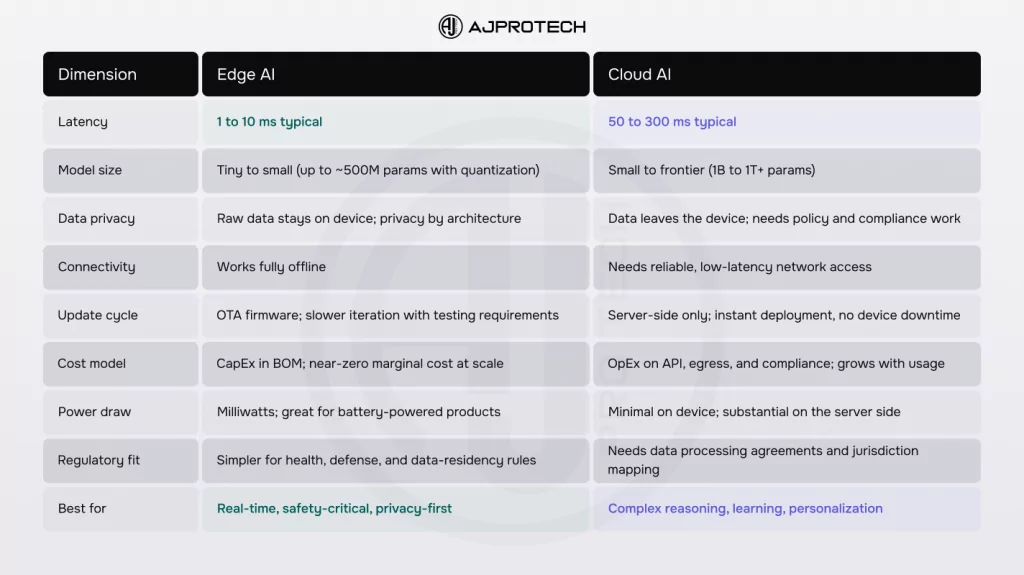
If the answer is under 20 milliseconds, think motor control, fall detection, audio wake-word recognition, or real-time quality inspection on a production line, the answer has to come from the device itself. A network round-trip takes 50 to 300 milliseconds on a good day. Physics will not cooperate.
If the answer can take a few seconds or longer, generating a health summary, analyzing a week of sensor data, responding to a complex voice query, the cloud opens up. Larger models, richer reasoning, and continuous learning from every device in your fleet all become possible.
Here is the insight that saves most hardware teams a great deal of pain: almost every product contains both kinds of decisions. The architecture question is not edge versus cloud. It is which decisions belong where, and how the two tiers pass information between them.
Map every AI decision in your product to a time budget and a data sensitivity level. The architecture follows naturally from that map.
What is edge AI?
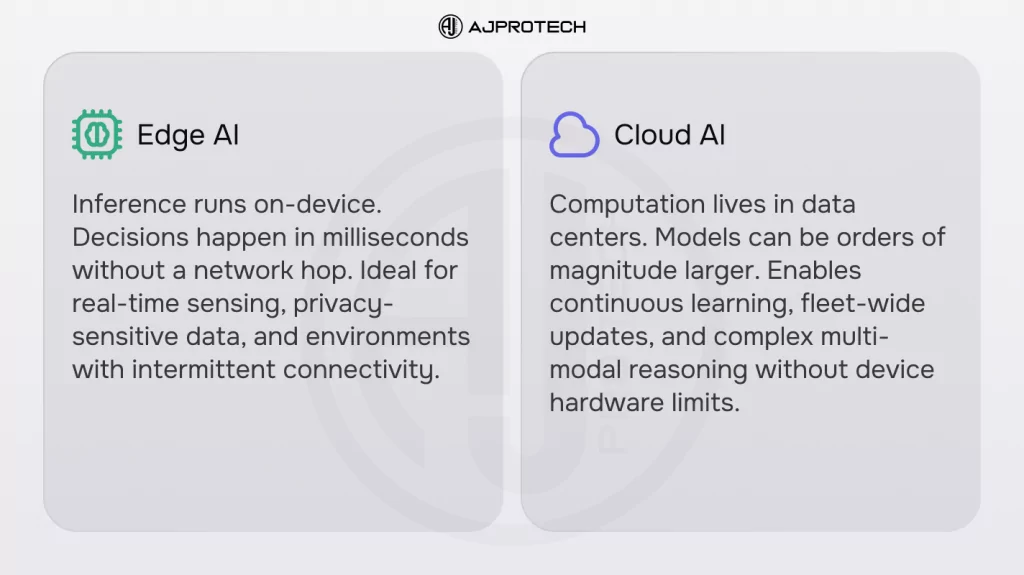
Edge AI means running machine learning inference directly on the device, without sending data to a remote server. The computation happens on embedded processors sitting inside your product: microcontrollers (MCUs), neural processing units (NPUs), or system-on-chip (SoC) designs that combine both.
The models running on these chips are optimized versions of larger models, compressed using techniques like quantization and pruning to fit within tight memory budgets, often under 1 MB of SRAM. Frameworks like TensorFlow Lite and the broader TinyML ecosystem have made this significantly more accessible over the past several years, but the hardware constraints are real and need to be respected at the design stage.
For the tasks it is suited to, edge AI is genuinely the better choice. A product that detects a manufacturing defect in 3 milliseconds using a $4 NPU is a faster, cheaper, and more reliable product for that specific job.
What is cloud AI, and what does it actually cost?
Cloud AI sends inference requests to remote servers with GPU clusters, large memory, and models that can be orders of magnitude more capable than anything running on embedded hardware. A frontier language model, a vision model that understands what a camera sees in natural language, a recommendation engine trained on millions of users: these live in the cloud, and they will for the foreseeable future.
The cost picture is more nuanced than it first appears. API call fees that look trivial in development compound quickly across thousands of daily active devices. Data egress fees add up. Connectivity failures need fallback plans. Every byte of raw sensor data that leaves the device introduces privacy considerations, especially under US state biometric data laws, HIPAA for health applications, and international data residency regulations.
None of this is a reason to avoid cloud AI. It is a reason to use it intentionally, only for the decisions that genuinely need it.
A practical decision framework
Why most production products use both
A layered architecture, where edge and cloud each handle what they do best, is the standard approach for well-engineered AI hardware products in the US market today.
Take a connected health monitor as an example. On the device, a dedicated health NPU runs continuous biosignal classification: arrhythmia detection, sleep stage scoring, activity recognition. This happens in under 10 ms, with no connectivity requirement. Every day, the device compresses and anonymizes a summary and sends it securely to a cloud backend, where a larger model performs longitudinal analysis, generates clinician-facing reports, and contributes to a fleet retraining pipeline. Updated on-device models return via OTA on a scheduled cycle.
Neither tier could do what the other does. The local NPU cannot run population-scale analysis. The cloud cannot classify an arrhythmia in real time. Together, they produce a product that is both clinically credible and commercially viable.
Planning for this architecture at the start of a project, rather than retrofitting it after launch, is the single biggest factor in whether an AI hardware product scales gracefully or accumulates technical debt with each new user.
A hybrid architecture is the natural outcome when latency and model capability are both treated as first-class requirements from the start.
What this means for startups building in the US market
US market expectations pull in two directions at once. Privacy-conscious buyers, FDA and HIPAA regulatory frameworks, and enterprise procurement requirements all favor architectures that keep sensitive data on the device. At the same time, consumer benchmarks for AI intelligence are set by cloud-native software products with effectively unlimited compute. Hardware products competing on AI capability have to meet both expectations.
For companies with engineering and manufacturing operations in both the US and Taiwan, the edge-cloud architecture question also intersects directly with supply chain decisions. The silicon you commit to in the BOM is a decision you live with across the product’s lifecycle. Getting it right requires knowing, from the first sprint, exactly what your device needs to compute locally and what it can safely defer to the cloud.
Common questions
What is the difference between edge AI and cloud AI?
Edge AI runs machine learning inference on the device itself, using embedded chips like microcontrollers or neural processing units. No data is sent to a remote server. Cloud AI offloads computation to data center infrastructure, enabling much larger models at the cost of added latency, network dependency, and data privacy considerations.
When should a hardware product use edge AI?
Use edge AI when your product needs to respond in under 20 milliseconds, must work without reliable connectivity, handles sensitive data that should stay on the device, or needs predictable low operating cost at high deployment volume. Common use cases include real-time sensor classification, safety interlocks, voice wake-word detection, and visual inspection on production lines.
Can a product use both edge and cloud AI at the same time?
Yes, and most well-designed AI hardware products do. A hybrid architecture assigns time-critical and privacy-sensitive decisions to on-device inference while routing complex reasoning, personalization, and continuous learning to the cloud. The two tiers communicate through compressed, anonymized data payloads on a schedule matched to the application’s needs.
What hardware does edge AI require?
Edge AI runs on a spectrum of hardware: general-purpose microcontrollers for lightweight TinyML models, dedicated NPUs for more demanding vision or audio tasks, and heterogeneous SoCs that combine CPU, GPU, and NPU cores for complex applications. The right choice depends on your model’s compute requirements, power budget, and bill-of-materials cost target.
How does edge AI help with privacy and regulatory compliance?
Because raw data never leaves the device, edge AI significantly simplifies compliance with US state biometric data laws, HIPAA for health applications, and international data residency regulations. This is a growing competitive advantage for hardware products sold into US enterprise and healthcare markets.