



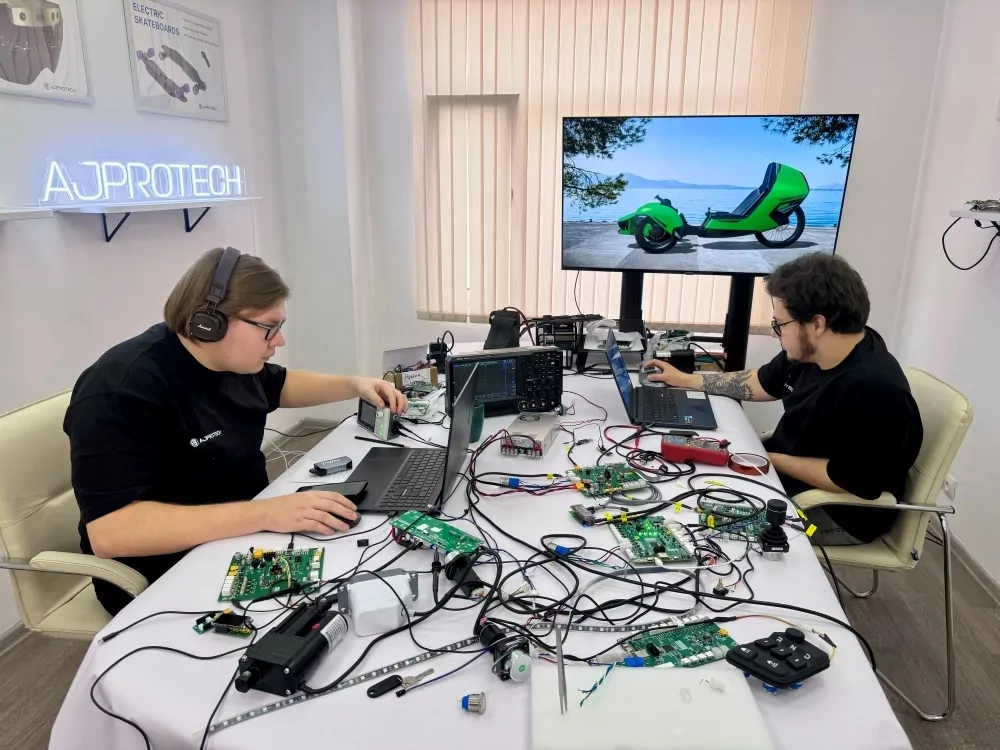
How to Use HIL Testing to Find Firmware Problems Earlier
Hardware-in-the-loop testing, or HIL, runs real firmware on the actual controller while the rest of the product is simulated. The test system can imitate sensors, batteries, motors, loads, and communication faults before the complete device exists.
This matters because firmware depends on real timing, voltage levels, interrupts, buses, and I/O behavior. Code that works on a PC can still fail when a CAN message arrives late, a sensor drops out, or a power rail behaves differently than expected.
A typical HIL setup includes:
- The real controller or MCU running production firmware.
- A real-time model of the battery, motor, mechanism, or other controlled system.
- Analog and digital I/O with signal conditioning.
- Emulated sensors and actuators.
- Communication links such as CAN, UART, or Ethernet.
- Logging and fault injection for brown-outs, open wires, stuck sensors, and dropped messages.
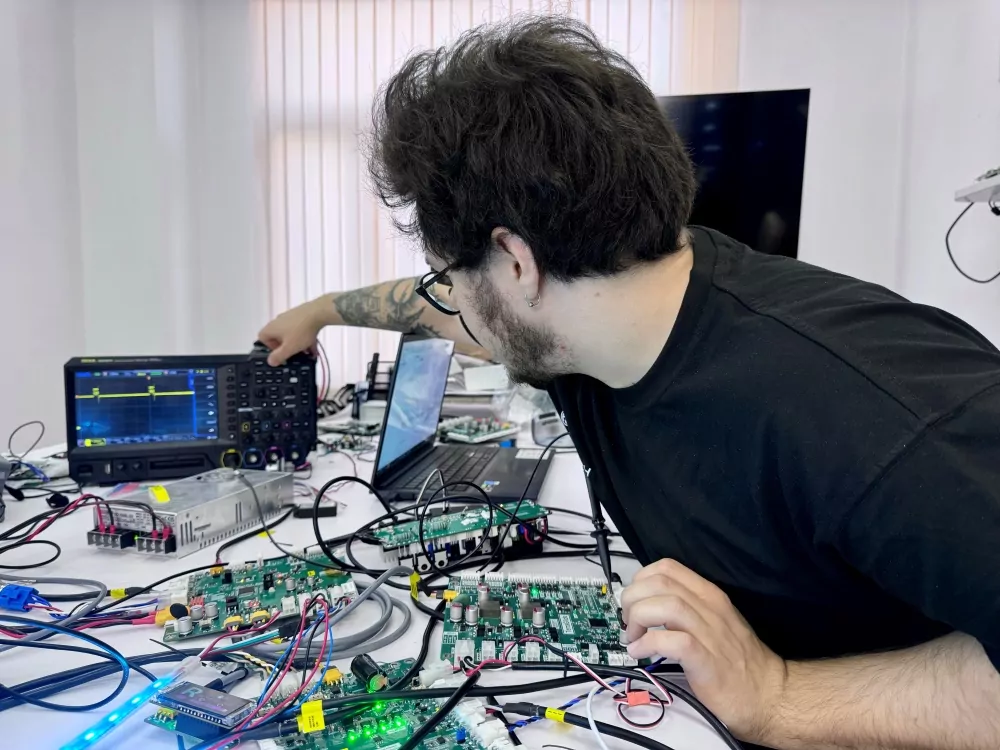
HIL is most valuable when hardware and firmware are being developed in parallel. Teams can build a regression suite before the full EVT prototype exists and rerun it whenever the firmware changes.
HIL vs Software-in-the-Loop and Full System Testing
HIL does not replace software simulation or physical product testing. Each stage catches a different class of problem.
| Stage | What is real | What it catches best |
| SIL | Firmware logic running on a PC | Algorithm, state-machine, and boundary-condition errors. |
| HIL | Real controller, firmware, I/O, and communications | Timing, interrupt, I/O, bus, and fault-response problems. |
| System test | Complete physical device | Thermal, EMC, mechanical, environmental, and user-interaction issues. |
A battery management system is a good example. Instead of creating dangerous faults on a live battery pack, the HIL rig can simulate:
- A cell voltage drifting too high.
- An open sense wire.
- Rising pack temperature.
- Lost Hall-sensor data.
- Delayed control commands.
- Malformed CAN messages.
- Brown-outs and communication failures.
The test script then checks whether the firmware enters the correct state, sends the correct output, and recovers properly when the fault clears.

HIL is especially useful when:
- Faults are unsafe or destructive to reproduce physically.
- Firmware changes frequently.
- Prototypes are scarce.
- Regression testing is long and repetitive.
- Battery, motor, robotics, or control-system behavior is complex.
Not every device needs a full HIL system. For a simple sensor product, SIL plus a bench setup with real components, test equipment, and scripted checks may be enough.
HIL in the Development and CI Workflow
The biggest value of HIL appears when testing becomes repeatable. Instead of manually checking firmware before every release, the controller can become part of the continuous integration process.
A practical workflow is:
- Build firmware after a commit or merge.
- Flash the controller on the HIL rig.
- Run normal and fault-injection scenarios.
- Capture timing, logs, outputs, and bus traffic.
- Compare results with written acceptance criteria.
- Store the test and plant-model version with the firmware revision.
This makes regressions visible close to the code change that caused them instead of weeks later during field testing.
HIL can begin before EVT and continue through DVT. It is particularly useful after PCB revisions, sensor substitutions, firmware updates, or power-stage changes. Physical validation is still required for thermal, EMC, mechanical, environmental, and manufacturing performance.
AJProTech helps teams plan firmware architecture and validation infrastructure around the risks that matter most. For controller-heavy products, battery systems, robotics, micromobility, and industrial hardware, early HIL testing can reduce expensive debugging after the complete product is already built.
FAQ
Does HIL testing replace EVT or DVT?
No. HIL validates firmware behavior, timing, communications, and fault handling. EVT and DVT still provide physical evidence for thermal, mechanical, EMC, environmental, and production-related performance.
Is HIL useful only for automotive products?
No. It is also useful for robotics, battery systems, micromobility, industrial controls, and connected devices where firmware must react reliably to sensors and faults.
What should teams simulate first?
Start with conditions that can damage hardware, create a safety risk, or block a release: voltage, current, temperature limits, communication loss, stuck sensors, open wires, and brown-outs.
How long does a HIL rig take to build?
A simple bench-level rig can take a few weeks. A larger real-time setup with batteries, motors, many signals, and deeper automation can take several months.
When is HIL worth the investment?
HIL is most valuable when firmware changes often, prototypes are limited, fault testing is risky, or repeated controller validation would otherwise consume significant bench and engineering time. Contact AJProTech for a feasibility study to ensure that this is the right call for your specific product.